Wednesday, February 26, 2014

Why do so many liberals want to suppress political speech?

Why do so many liberals want to suppress political speech?

By    

Beltway Confidential,Opinion,Michael Barone,Freedom of Speech,Media,FCC
The knee jerk response of many liberals to political attacks seems to be to suppress such speech. Examples abound. Michigan Rep. Gary Peters, running for the Senate, threatens the broadcast licenses of stations that run ads criticizing him. Over at salon.com Fred Jerome imagines what it would be like to nationalize -- have the government take over -- Fox News. And of course evidence continues to accumulate that high Internal Revenue Service officials denied approval to conservative groups in order to suppress political speech.


Then there's the Federal Communications Commission's “Multi-Market Study of Critical Information Needs”--put on hold Friday. The FCC was going to query TV station and newspaper writers about their “coverage choices.” As my Washington Examiner colleague Byron York explains, this “study” was the project of Democratic FCC Commissioner Mignon Clyburn, daughter of Rep. James Clyburn, and it was scheduled to be rolled out first in Columbia, S.C. -- which just happens to be the Clyburns' hometown.
The amazing thing is that this wacky project, which was supposedly based on the need to identify barriers to entry for entrepreneurs and small businessmen in broadcast businesses, was humming along without demur until, in a Feb. 10 opinion article in the Wall Street Journal, Republican FCC Commissioner Ajit Pai blew the whistle. “How can the news judgments made by editors and station managers impede small businessmen from entering the broadcast industry?” he asked. “And why does the CIN study include newspapers when the FCC has no authority to regulate print media?” Even after that appeared, it was not until Feb. 21 that FCC Chairman Tom Wheeler, at least temporarily, shut the project down. Wheeler, a successful communications venture capitalist and lobbyist, is obviously a smart person; the fact that it took him more than an instant to stop this ridiculous process shows the strength of the liberal impulse to suppress speech.
Some of us are old enough to remember when liberals’ response to speech they disagreed with was: more speech. The reflexive response of many liberals today seems to be: shut it down.


http://washingtonexaminer.com/why-do-so-many-liberals-want-to-suppress-political-speech/article/2544453

The United States of Decline (pt 2)


The United States of Decline
America unravels at an increasingly dizzying pace.


Nearby, embattled Syrians flee the city of Homs while they and their United Nations protectors dodge incoming mortar shells. This sorry spectacle has exposed Obama’s Syrian policy as a miserable flop. So does the fact that Syrian president Bashar Assad has handed over only 4 percent of the chemical weapons that his deal last September with Obama and Vladimir Putin was supposed to neutralize. According to GOP senators John McCain of Arizona and Lindsey Graham of South Carolina, Secretary of State John Kerry privately conceded to them that Obama’s approach in Syria has failed.
America liberated Afghanistan from a regime that hosted al-Qaeda, banned kites and recorded music, and built a bridge to the seventh century. And what thanks does the U.S. get? Over American objections, Afghan president Hamid Karzai last week released 65 Taliban warriors from Bagram prison, where they were being held on suspicion of killing American troops, murdering Afghan civilians, deploying roadside bombs, and otherwise perpetrating mayhem. When U.S. officials complained that these killers could return to the fight — as have other Taliban thugs, once freed — Karzai exploded: “If the Afghan judicial authorities decide to release a prisoner, it is of no concern to the U.S. I hope that the U.S. will stop harassing Afghanistan’s procedures and judicial authority, and I hope the U.S. will now begin to respect Afghan sovereignty.”

For these and many other reasons, Democrats are fleeing Obama.
“I don’t care to have him campaign for me,” said Senator Mark Begich (D., Alaska).
A reelection ad for Representative Joe Garcia (D., Fla.) boasts that “he voted to let you keep your existing health plan, and he took the White House to task for the disastrous healthcare website.”
“He [Obama] is hurting the Democratic brand right now,” veteran Democratic campaign strategist Joe Trippi told Fox News Channel’s Megyn Kelly on February 12. “The Obamacare snafus, his approval rating is declining, and his credibility problems all drag the Democratic brand down.”
Rather than resist an increasingly weak — yet ever more assertive — Obama, GOP congressional leaders hand him whatever he wants. Thus, House speaker John Boehner and Senate GOP chief Mitch McConnell of Kentucky pushed through a $1.012 trillion budget with, at best, minuscule and illusory spending cuts. A $956 billion farm bill includes $3 million to promote Christmas trees (who on Earth would buy them without federal assistance?), $100 million for maple-syrup market research, and $170 million for catfish protectionism. Boehner and McConnell sent Obama this gift-wrapped monstrosity, which was $56 billion higher than Obamacare’s original price tag. And in exchange, Obama gave them . . . zippo!
On February 12, Boehner and McConnell helped send Obama a measure to suspend the debt limit until March 15, 2015. (The debt ceiling was not raised from $17.2 trillion to a higher level; it simply was removed. The gas pedal remains in Obama’s Little Red Cor-debt, but the brakes are gone.) This passed the GOP House with Boehner and only 27 Republicans voting yes. The other 194 votes were from Democrats. When McConnell surrendered on cloture, 11 other Republican senators helped Democrats advance their dirty work. The debt ceiling is now a debt sunroof.
And what did Washington’s top two Republicans get for giving Obama 13 months to shop till America drops? Nothing! No repeal of Obamacare’s $47 billion bailout of health insurers. No approval of the Keystone XL Pipeline. No termination of the cure-killing medical-device tax. No votes on these matters, which would have forced Democrats to choose. This could have helped Republican candidates in November.
Steely resolve could stymie the unpopular and untrustworthy Obama. Sadly, Boehner, McConnell, and other GOP leaders are as firm as foil.
Happy Valentine’s Day! The Senate Conservatives Fund has broken up with House Speaker John Boehner.
“Republicans are giving up because they know that winning is impossible when their leaders are determined to lose,” the Senate Conservatives Fund stated. “These leaders have telegraphed weakness to the Democrats and sabotaged conservative efforts so many times that Republicans now have no leverage.” The group concluded: “John Boehner must be replaced as Speaker of the House. . . . Unless we install a new leader who will actually go on offense, Democrats will never fear us and we will never have any leverage.”
Also, Earth’s sole superpower is sagging where it should be No. 1. America has slouched to No. 12 on the 2014 Heritage Foundation/Wall Street Journal Index of Economic Freedom.
“Now considered only a ‘mostly free’ economy, the U.S. has earned the dubious distinction of having recorded one of the longest sustained declines in economic freedom, second only to Argentina, of any country in the [20-year] history of the Index,” the report states. “The U.S. is the only country to have recorded a loss of economic freedom each of the past seven years.”
Regarding graft, America has stayed stable in Transparency International’s Corruption Perceptions Index. Unfortunately, and as recently as 2013, the U.S. has remained Earth’s 19th most honest country.
Thanks, in part, to Team Obama’s surveillance of journalists from Fox News Channel and the Associated Press, America tumbled 13 spots down Reporters Without Borders’ 2014 World Press Freedom Index. The U.S. dropped this year from No. 33 to No. 46. Hence, 45 nations now have freer journalists than does America. RWB calls America “satisfactory” rather than the top-rated “good.” As the report states: “Amid an all-out hunt for leaks and sources, 2013 will also be the year of the Associated Press scandal, which came to light when the Department of Justice acknowledged that it had seized the news agency’s phone records.”
America is a total mess.
The Land of the Free is governed by an out-of-control egomaniac, neither bolstered by managerial competence nor hindered by the legislature’s institutional prerogatives. In the Home of the Brave, half of Congress cheers Obama’s unconstitutional behavior, while the other half grumbles and then meekly carpet-bombs his path with white flags.
The American people have been betrayed — both by Obama and the Democrats, whose lust for control intensifies daily, and by Republican leaders in Washington, whose cowardice and defeatism have turned their guts and spines into tapioca.
America, as Paul Simon sings, is slip-slidin’ away. And the worst part hasn’t happened yet.

— Deroy Murdock is a Manhattan-based Fox News contributor and a media fellow with the Hoover Institution on War, Revolution and Peace at Stanford University.

Tuesday, February 25, 2014

Administration Lawlessness? Executive Orders Aren’t the Half of It

Administration Lawlessness? Executive Orders Aren’t the Half of It.
by Clark S. Judge: managing director, White House Writers Group, Inc.; chairman, Pacific Research Institute
 
Talk about a smokescreen.
When President Obama pledged to use executive orders to do what he couldn’t get Congress to do, no one thought such an extreme, in-your-face challenge could be a diversion. But it now looks as though that is what it might have been.
For some of the most extreme unilateral administration actions are turning out to be not the work of the presidential pen but actions taken in bureaucratic darkness. I’m talking about quiet extensions of agency authority and adjustments in the interpretation of complex laws either though quietly released new regulations or even bypassing the formal regulatory process.
On Monday, the Washington Examiner reported (http://washex.am/1gUSD4U) that the administration is considering extending the “risk corridors” in the Affordable Care Act. “Risk Corridors” are Obamcarespeak for what was initially labeled as insurance for health insurance companies that participated in the government insurance scheme. Companies would pay into a pool from which those who suffered losses would be compensated. Now it is clear that corridors are not insurance but subsidies, essentially bailouts from the universal losses that the program imposes.
The problem is that the bailout expires in the law itself in 2016. So the administration, on its own, according to the Examiner, is preparing to extend it.
This morning at the Volokh Conspiracy (newly acquired by the Washington Post and the nation’s most widely read and respected legal blog) Case-Western law professor Jonathan Adler writes (http://wapo.st/1fdiGGl), “Nowhere that I can find does the [Obamacare] law provide for, or otherwise authorize, risk corridors past 2016, nor have I found language that could serve as a generic authorization for this initiative.” He adds, “Were that not bad enough, the Administration also lacks the authority to authorize insurance companies to renew noncompliant policies (a point which some of the Administration’s defenders now concede).”
Here is the point. This contemplated move was clearly not on the way to being trumpeted from a lectern in the White House’s Rose Garden. Rather, the instrument of implementation was to be a reinterpreted regulation or some other surreptitious device.
That is speculation, of course, but informed speculation. For it is just the way Team Obama has gone about extending another of its monster, thousand-plus-page laws: the Dodd-Frank financial reform act, like the ACA enacted by the uberDemocratic Congress of the President’s first two years in office.
For two years now, the Administration has been trying to bring mutual funds under the scope of that law. Originally they wanted the Securities and Exchange Commission to enact rules that would have imposed on the industry regulations more or less parallel to Dodd-Frank. But a Democratic commissioner sided with the panel’s two Republicans in blocking the move.
So after frustration on other procedurally valid fronts, the Administration took a different tack. As reported on the Wall Street Journal editorial page in December (http://on.wsj.com/1blamTN):
Retired House Democrat Barney Frank is the last person on the planet you’d expect to criticize implementation of the 2010 law that bears his name. But there he was at a recent event hosted by the Clearing House trade group, suggesting that regulators ought to focus on banks instead of mutual-fund companies.
According to the Clearing House, Mr. Frank said he did not favor designating such large asset managers as BlackRock or Fidelity as “systemically important” and that this was not the intent of his law. He added that “overloading the circuits isn’t a good idea” and said that the Financial Stability Oversight Council created by Dodd-Frank “has enough to do regulating the institutions that are clearly meant to be covered—the large banks.” Mr. Frank told the crowd, “I have not seen the argument made yet to cover” the “very plain-vanilla asset managers.”

The point here is that, as appeared destined to happen with Obamacare’s risk corridors before the Examiner blew the whistle, Administration-imposed changes in the Dodd-Frank law were not the product of a presidential pen and were not trumpeted in the White House Press Room. They were being executed beyond public view, and, as Mr. Frank made clear, against the intent of a law whose intent he knows better than anyone else.
In recent days, new IRS attempts to stifle free speech have come to light (http://bit.ly/1bLfK3a). Who knows what else is quietly bubbling in the cauldrons of agencies?
The Constitution disperses power among the branches of government and between levels of government to prevent unilateral action and force publicly conducted deliberation. Mr. Obama has made it clear that public deliberation and the compromises that go with it are not for him. The question now is, are they for the rest of us?
 

The United States of Decline (pt 1)

The United States of Decline
America unravels at an increasingly dizzying pace.
By Deroy Murdock

Don's Tuesday column


      THE WAY I SEE IT   by Don Polson  Red Bluff Daily News   2/25/2014

Crime and punishment—Jefferson style?


During District Attorney Greg Cohen’s time with the Tea Party Patriots, he did his best to provide attendees a frank, if somewhat brutal, picture of the state of criminal prosecution and justice in Tehama County. Given the harsh reality of civic life under the imposed incarceration standards of AB 109, or “realignment,” Mr. Cohen used his hands to simplify the quandary facing local criminal prosecutors:

Holding one hand at a level above his head, he explained that that represented the relative number of crimes considered “serious” or “felonies.” His other hand was above his head but a bit short of the first hand. He explained that that hand represented how many of those serious crimes would have resulted in state prison terms prior to AB 109, Gov. Brown’s response to judicially mandated reductions of inmate populations. The euphemism “realignment” says simply that criminals are remanded back to local and county jails, probation and enforcement personnel—all never designed nor intended to deal with serious and repeat offenders who deserve hard time in state penitentiaries.

Then he moved the second hand down near his waist to dramatically illustrate the level of those crimes that will realistically result in a state prison sentence. His prosecutors know this, law enforcement knows this, and the criminals know it all too well. State Senator Jim Nielsen has labored mightily to call attention to the terrible injustice of it all, while disingenuous Democrat and news media mouthpieces downplay the obvious surge of resulting crime. It calls for citizens to take their own security in hand—handguns carried with proper permits wherever possible—because when seconds count, the police are only minutes away.

I did not put Cohen on the spot with a question about how things could be different if Tehama County, together with similarly minded rural counties of California, were no longer under the judicial and legal authority of Sacramento. It’s not his issue but it is mine to the extent of being able to think through some applicable scenarios.

Existing state prisons could be acquired for some reasonable terms. Over time, inmates originating from California could be returned there; likewise, inmates in California from the counties forming the State of Jefferson would transfer here. Correctional officers would be informed that their employment is terminated unless they wish to take pay reductions more reflective of the market rate for such personnel, absent union-driven exorbitant salaries and benefits. New prisons, if required, could be built far more economically without the outrageous, mandated union scales of “prevailing wage” rules.

Rather than turning serious offenders loose on innocent civilian populations, they could be packed to the walls until such new facilities are completed, including field-tent operations for the low-risk prisoners that have earned such security arrangements. If judges decide against the State of Jefferson’s prison regimen, let them get their like-minded judges together and try to enforce their judicial fiats. Prisoner health care? Just the basics, please.

Anyone saying the State of Jefferson would be short of potential revenue for things as basic as law enforcement, prosecution and incarceration, should consider how much revenue would come from a booming economy, labor force and retail businesses free of sales taxes. Blessed with abundant opportunities no longer present in the over-regulated, over-taxed, highly welfare-dependent California status quo, jobs would explode. A truly conservative governor and legislature would, first and foremost, provide essential security to Jeffersonian citizens. They could also figure out how anyone with the means and desire to start a business could be expedited through a streamlined permitting process—let the moving vans be welcomed at our borders and unload the productive but formerly “Californi-cated” people yearning for economic freedom here.

In fact, with a few more states like Jefferson, the balance could even tip in Washington toward a more conservative Senate and an Electoral College advantage in presidential elections. Upon Obamacare’s repeal, free-market solutions to health care affordability and access could more easily be implemented, particularly by allowing states the flexibility they need, not currently available under Medicaid mandates, to provide health care to the truly indigent.

On a related note, Covered California follies proceed apace: “Facing a $78 million budget shortfall, California’s ObamaCare exchange has spent $1.37 million to fund an outreach featuring exercise guru Richard Simmons gyrating on the floor and hugging a contortionist who is kneeling with his buttocks in the air.” (Noted by NorCal Republican State Senator, Ted Gaines, reported by Foxnews.com, 1/30)

“In California, policies for about 900,000 Californians are being canceled because of ObamaCare’s mandates, and about two-thirds of these do not qualify for subsidies. The result: These folks will be paying higher premiums.” (1/04, Chicago Tribune) About 500,000 were enrolled in Covered California through Dec. 31 (latimes.com). So, almost twice as many lost insurance as were signed up for Obamacare in our state, same ratio as the whole nation.

Finally, I offer my antagonistic colleague some cheese (a little brie, perhaps?) to go with his “whine,” as I see it, over our local “extremely conservative climate,” “animosity among the electorate,” my “continuous diatribes,” as well as apparent supporters who “don’t hesitate to condemn and vilify,” with “harangues” directed at “everyone who speaks to the contrary.” Poor besieged liberal! Did Joan of Arc ever have such a burden?

Monday, February 24, 2014

Jakarta japes

Jakarta japes

by Scott Johnson in Climate, John Kerry, Obama Foreign Policy
For those who lack a rooting interest in the United States, American foreign policy has become a joke. We are fools who appear to lack the most elementary ability to distinguish friend from enemy. Functionally speaking, we’ve gone over to the other side — “the other side” being the side of our enemies. Those who wish us ill — both at home and abroad — have a friend in John Kerry, speaking yesterday in Jakarta.
The Year of Living Dangerously was set in Jakarta, was it not? That works too. From the detached point of view, however, we’re living comically in the Age of Obama. Kerry chose Jakarta as the scene for one of the Obama administration’s classic routines (text here). The AP reports:
“We simply don’t have time to let a few loud interest groups hijack the climate conversation,” he said, referring to what he called “big companies” that “don’t want to change and spend a lot of money” to act to reduce the risks.
Kerry later singled out major oil and coal concerns as the primary offenders.
“We should not allow a tiny minority of shoddy scientists and science and extreme ideologues to compete with scientific facts,” Kerry told the audience at a U.S. Embassy-run American Center in a shopping mall.
“Nor should we allow any room for those who think that the costs associated with doing the right thing outweigh the benefits.”
“The science is unequivocal, and those who refuse to believe it are simply burying their heads in the sand,” Kerry said. “We don’t have time for a meeting anywhere of the Flat Earth Society,”
Kerry said the cost of inaction will far outweigh the significant expense of reducing greenhouse gas emissions that trap solar heat in the atmosphere and contribute to the Earth’s rising temperatures.
He outlined a litany of recent weather disasters, particularly flooding and typhoons in Asia, and their impact on commerce, agriculture, fishing and daily living conditions for billions of people.
“This city, this country, this region, is really on the front lines of climate change,” Kerry said. “It’s not an exaggeration to say that your entire way of life here is at risk.”
He added: “In a sense, climate change can now be considered the world’s largest weapon of mass destruction, perhaps even, the world’s most fearsome weapon of mass destruction.”
“In a sense,” anything can now be considered anything. You’d think the Secretary of State would be tuned into the forces that seriously vie for consideration as the world’s most fearsome weapons of mass destruction. Only in the realm of comedy is “climate change” considered the world’s most fearsome weapon of mass destruction.
So how did Kerry’s routine go over in Jakarta? Inquiring minds want to know. The AP report doesn’t say, though it does offer this concluding note: “Before the climate change speech, Kerry toured Jakarta’s Istiqlal Mosque, one of the largest in the world, to pay his respects to Indonesia’s Muslim majority population” (concerning which, more here).

http://www.powerlineblog.com/archives/2014/02/jakarta-japes.php#!

A Galling Betrayal

A Galling Betrayal
In Iraq and Afghanistan we won the war and lost the peace.

Afghan president Hamid Karzai


The Afghanistan government’s recent release of dozens of imprisoned terrorists, many of whom had killed Americans, was a galling betrayal of those Americans who died defending Afghanistan against the Taliban terrorists — as well as those Americans who have returned home with arms or legs missing, or with minds traumatized beyond repair.
If we learn nothing else from the bitter tragedy of the war in Afghanistan, it should be that we should put an end forever to the self-indulgence of thinking that we can engage in “nation-building” and creating “democracy” in countries where nothing resembling democracy has ever existed.
It would be a feat to achieve one of these objectives, but to achieve both at the same time is a gamble that makes playing Russian roulette look like a harmless pastime.
F. A. Hayek said, “We shall not grow wiser until we learn that much that we have done was very foolish.” Nothing is more foolish — and immoral — than sending men into battle to risk their lives winning victories that are later lost by politicians for political reasons.
That started long before the war in Afghanistan. Vietnam was a classic example. Years after that war was over, the Communist victors themselves admitted that they lost militarily in Vietnam, as they knew they would. But they won politically in America, with the help of Americans, including the media — as they also knew they would.
The war in Iraq was more of the same. American troops won that war, but our politicians lost the peace. Terrorists have now taken over and raised al-Qaeda flags in some Iraqi towns that American troops liberated at the cost of many lives.
How did this happen? It happened much the same way it happened in Afghanistan. We insisted on trying to create a “democracy” in the Middle East — a place with a history going back thousands of years without a single democracy.
What we created instead was a local ruler, placed in charge as a result of the blood and treasure of Americans, but independent of us, because he won an election that we insisted on holding — as if there are no prerequisites for democracy.
To compound the problem, we had members of Congress constantly talking about pulling out of Iraq and demanding a timetable — despite what military madness it is to tell your enemy when you will be gone.
With American military support likely to be temporary and Iran’s military presence next door certain to be permanent, how surprising is it that Iraq’s leadership took Iran much more seriously than it took the United States?
Today, the Iraqi government is much more accommodating to Iran than to the United States, despite the fact that Americans put them in power. The very same scenario was repeated in Afghanistan, with President Obama himself announcing a timetable for the withdrawal of American troops.
Afghan president Hamid Karzai saw the writing on the wall — and what it said was that American support was temporary but the Taliban was going to be around long after the Americans were gone. He too decided that it was better to try to get on the good side of our enemies, in this case by turning loose some terrorists.
It doesn’t have to be this way.
After World War II, the American military took over the governments of Japan and West Germany. We did not start out by setting up some local leader who would be able to put his own interests above ours and work at cross purposes against us. Nor did we announce to the whole world when we planned to start reducing our troop levels in these countries.
Under the unchallenged supremacy of General Douglas MacArthur, Japan was indeed turned into a very different country, one in which democratic institutions could be phased in, at whatever pace the circumstances made prudent. Something similar happened in West Germany.
But this was not something that could be done quickly or on the cheap, with politicians sounding off in Congress about pulling out, and trying to micromanage from thousands of miles away. If we can’t be serious, we have no right to send young Americans out into the hell of war.
Thomas Sowell is a senior fellow at the Hoover Institution. © 2014 Creators Syndicate Inc.

http://www.nationalreview.com/article/371321/galling-betrayal-thomas-sowell#!

Why Hillary Clinton's past is fair game in presidential race

Why Hillary Clinton's past is fair game in presidential race

By                             
Politics,Opinion,Byron York,Columnists,Hillary Clinton,Bill Clinton,2016 Elections,Campaigns,Kenneth Starr,Whitewater
There's a debate going on about Hillary Clinton's past. If she runs for president in 2016, should Republicans reach back to the scandals of her years as First Lady? Or should they focus on more recent times, especially her tenure as Secretary of State, to build a case against her?
The GOP doesn't have to choose. Of course Clinton's recent experiences are relevant to a presidential run. But so are her actions in the 90s, the 80s and even the 70s. It's not ancient history; it reveals something about who Clinton was and still is. And re-examining her past is entirely consistent with practices in recent campaigns.
In the 2012 presidential race, for example, many in the press were very interested in business deals Mitt Romney made in the 1980s. In the 2004 race, many journalists were even more interested in what George W. Bush did with the Texas Air National Guard in 1968, as well as what John Kerry did in Vietnam that same year. And in 2000, a lot of journalists invested a lot of time trying to find proof that Bush had used cocaine three decades earlier.


So by the standards set in coverage of other candidates, Clinton's past is not too far past.
That's especially true because there will be millions of young voters in 2016 who know little about the Clinton White House. Americans who had not even been born when Bill Clinton first took the oath of office in 1993 will be eligible to vote two years from now. They need to know that Hillary Clinton has been more than Secretary of State.
Those voters need to know, for starters, that Mrs. Clinton once displayed incredible investment skills. In 1978 and 1979, when her husband was attorney general and then governor of Arkansas, she enlisted the help of a well-connected crony to invest $1,000 in the highly volatile and risky cattle futures market. Several months later, she walked away with $100,000 -- a 10,000-percent profit. Cynics thought the well-connected crony who executed the trades might have paid her the profits from good trades and absorbed the losses from bad ones, but Mrs. Clinton insisted that she developed her investing acumen by reading the Wall Street Journal.
New voters also need to learn about Mrs. Clinton's checkered history as a lawyer and the game of hide-and-seek she played with federal prosecutors who subpoenaed her old billing records as part of the Whitewater investigation. After two years of defying subpoenas and not producing the records, she suddenly claimed that they had been in a closet in the White House residence all along.
New voters also need to learn about Mrs. Clinton's purge of the White House travel office, which was done to steer business to another Clinton crony. There's no doubt she directed the 1993 firings of long-time White House employees although she testified under oath that she did not. Years later, prosecutors concluded that "Mrs. Clinton's sworn testimony … is factually inaccurate."
Finally, there is the Lewinsky scandal, which Sen. Rand Paul, R-Ky., has somewhat clumsily brought into the political discussion. In 1998 and 1999, Mrs. Clinton essentially played two roles, that of wronged wife and that of strategist and spokeswoman in a concerted White House attack-the-prosecutor misdirection campaign.
The reason there is the phrase "vast right-wing conspiracy" is that Mrs. Clinton unveiled it shortly after the scandal broke, in a mostly-successful effort to divert press attention away from President Clinton's behavior and instead to independent counsel Kenneth Starr and some anti-Clinton groups.
"The great story here, for anybody willing to find it and write about it and explain it, is this vast right-wing conspiracy that has been conspiring against my husband since the day he announced for president," Clinton said on the Today Show in January 1998. What followed was a long, hyperventilating and mostly irrelevant diversion campaign — Look! Ken Starr was once a tobacco lawyer! — that would be a model for guilty defendants everywhere.
Mrs. Clinton's past was an issue in 2000 when (while still First Lady) she ran for a Senate seat from New York. Obviously it didn't keep her from winning in that Democratic state.
Even in a national contest, a focus on Mrs. Clinton's past likely won't decide the outcome any more than Romney's time at Bain Capital decided the 2012 race. But it will help define Mrs. Clinton for millions of voters who weren't around or weren't paying attention in the 1990s. They need to know. And that's what campaigns are for.


http://washingtonexaminer.com/byron-york-why-hillary-clintons-past-is-fair-game-in-presidential-race/article/2544147

Sunday, February 23, 2014

So What Was The Point of Obamacare Again?

So What Was The Point of Obamacare Again?
 
As Rich noted the other day, the Wall Street Journal reported over the weekend that the uninsured haven’t been rushing to sign up for insurance under Obamacare. From the WSJ:
Early signals suggest the majority of the 2.2 million people who sought to enroll in private insurance through new marketplaces through Dec. 28 were previously covered elsewhere, raising questions about how swiftly this part of the health overhaul will be able to make a significant dent in the number of uninsured.
Insurers, brokers and consultants estimate at least two-thirds of those consumers previously bought their own coverage or were enrolled in employer-backed plans.
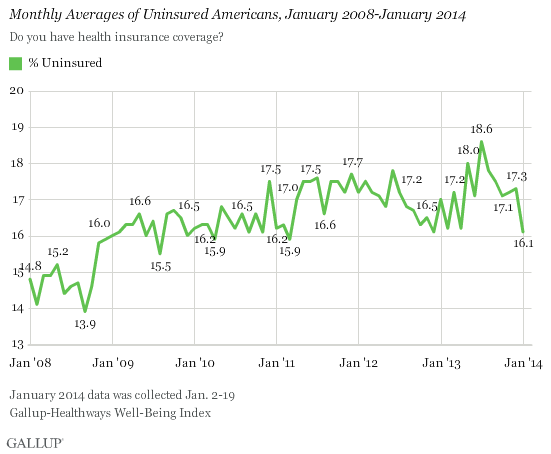
Note, this is after decades of liberals insisting that the uninsured were desperate to get insurance and years of Obama officials and defenders swearing that this law would make it happen. Indeed, in order to make it happen the Democrats blew up the entire health-care industry casting millions of people off their existing insurance plans. When those people went to exchanges to sign up for new ones, the Obama administration took credit for it, as if they were doing something for the uninsured. But barely 1 in 10 of new Obamacare enrollees were previously uninsured.
Look at this chart from Gallup:
I joked on Twitter this morning, ”They said if I voted for Mitt Romney, the ranks of the uninsured would continue to swell. And they were right!” (Every time I make that joke, I send Glenn Reynolds a quarter).
The response from some liberals in my feed boiled down to “He inherited a financial crisis!”
And that’s absolutely true. But that was a long time ago and this administration long ago declared we were in a recovery. Oh and he also blew up the entire health-insurance industry in response, insisting that it was absolutely necessary not only to fix the bad economy (which was always a stretch) but to deal with the ongoing crisis of the uninsured. It turns out it did neither. It created more uninsured people than it gave insurance to. And it promises to create even more.

http://www.nationalreview.com/corner/369238/so-what-was-point-obamacare-again-jonah-goldberg#!

Will Bill Clinton Be an Issue In 2016?

Will Bill Clinton Be an Issue In 2016? [Updated]

by John Hinderaker in 2016 presidential election, Bill Clinton, Hillary Clinton
As so often happens these days, it was Rand Paul who first raised the subject. Or, rather, his wife did. Senator Paul was a guest on Meet the Press when host David Gregory asked him to comment on an interview in Vogue in which Kelley Paul said, “Bill Clinton’s relationship with Monica Lewinsky should complicate his return to the White House, even as first spouse. I would say his behavior was predatory, offensive to women.” Paul responded mildly to Gregory, saying that the Lewinsky affair would impact how Bill Clinton is judged by history, while also noting that “with regard to the Clintons, …sometimes it’s hard to separate one from the other.”
Rand Paul returned to the theme a week or two later, saying that Democrats shouldn’t be advocating for women’s rights while using Bill Clinton to raise money. A salient point, since Clinton–Bill, not Hillary–is the Democrats’ most effective fundraiser.
Some have criticized Paul’s attacks on Bill Clinton, and others, including Mitt Romney, have argued that the former president should not be an issue in the 2016 campaign, assuming that his wife is a candidate. At the same time, others have joined Paul in questioning whether Bill Clinton’s many transgressions should disappear down the memory hole. Kathleen Willey, one of Bill Clinton’s victims, not only has spoken up, but has linked Bill’s harassment of her to his wife’s campaign:
“Hillary Clinton is the war on women, and that’s what needs to be exposed here,” Willey said Sunday night on Aaron Klein’s WABC Radio show.
“The point is what this woman is capable of doing to other women while she’s running a campaign basically on women’s issues. It just doesn’t make any sense. She singlehandedly orchestrated every one of the investigations of all these women [who accused her husband of sexual crimes].”
Glenn Loury, too, wondered why Bill Clinton gets a free pass:
Glenn Loury asks: How does Bill Clinton “get to go around and be an honorable defender of the Democratic Party line, which is a pro-woman line, when he took advantage of an intern in his office? And, you know, I’m not a pro-impeach-Bill-Clinton guy and whatnot, but I kind of find it hard to see that Rand Paul doesn’t have a point there, okay? How is it that the press and everybody else can just forget about the exploitation of women when they’re actually exploited and yet are prepared to level their howitzers of criticism on any Republican who might say something that could be construed as anti-woman, who hasn’t been messing around with the interns under his charge?”
It’s been a long time since most of us have thought about Clinton’s “bimbo eruptions,” but the names bring back the memories: Gennifer Flowers, Kathleen Willey, Juanita Broaddrick, Paula Jones. And, of course, Monica Lewinsky. But Monica isn’t the worst; Willey accused Clinton of an actual, physical assault, and Broaddrick asserted a credible claim of rape. Clinton paid Jones a lot of money to settle her sexual harassment case, committed perjury in the course of that lawsuit, paid a fine and lost his law license. The facts are really quite a bit worse than many people seem to realize.
But will any of this be fair game in 2016? Normally, of course, a political candidate’s spouse is more or less off limits. But it would be absurd to think of Bill Clinton as merely a First Husband. Here are some reasons why, in my view, Bill Clinton is likely to emerge as a political issue in 2016:
1) It is, as Rand Paul said, often hard to tell where one Clinton ends and the other begins. Remember in 1992 when Bill offered Hillary up as a potential co-president, suggesting that if we voted for him, we would get “two for the price of one?” Moreover, Bill is obviously the dominant member of the couple. He is the pre-eminent political genius of his generation, while no one would ever have heard of Hillary if she hadn’t married Bill. It would be foolish to imagine that Hillary could be president, without wondering what influence the far more able and experienced Bill would be wielding behind the scenes.
2) Hillary’s appeal as a candidate will consist largely of nostalgia for Bill’s two terms in office. A key issue in 2016–probably the key issue–will be which candidate has the best ideas to get the economy moving again. Is it conceivable that Hillary can refrain from harkening back to Bill’s tenure in the 1990s, and implying that we should elect her to bring back those good times? No. Apart from being the first woman president, that is the only plausible reason for electing her.
3) Bill Clinton is incapable of staying on the sidelines. He is the Democrats’ most popular figure, and Hillary’s best weapon. He will be a leading figure in her campaign. Is it possible for Bill to be front and center as a fundraiser and an advocate, running interference for his wife and vouching for her competence, while at the same time remaining shielded from any scrutiny? I don’t think so.
4) Hillary cannot be entirely divorced from Bill’s history. On the contrary, she was at a minimum an enabler, and she may have been involved in planning attacks on women like Kathleen Willey and Juanita Broaddrick. The issue here is not one of Bill Clinton having affairs; that would no doubt be a much longer list in which no one (probably including Hillary) has much interest. Rather, as noted, in Broaddrick’s case in particular, the allegation involved a felony which, if successfully prosecuted, would result in a long jail term.
5) There is every reason to expect the Democrats to reprise their “war on women” theme in 2016. Glenn Loury and Rand Paul aren’t the only ones who will think that if Hillary whistles that tune, she is the world’s biggest hypocrite. That is a judgment on Hillary, not Bill.
And finally: in a presidential election, pretty much everything can be relevant. If Mitt Romney putting a dog on the roof of his car can become a campaign issue, so can Hillary Clinton’s acquiescence in Bill’s string of alleged sexual assaults.
Bill Clinton’s past is not an issue that the Republican nominee will talk about, nor should he (or she). And the press will, of course, try to suppress any reference to the sordid aspects of the Clintons’ history, while at the same time talking up Bill Clinton’s presumed successes as president. But that suppression can succeed only up to a point. If Hillary Clinton thinks the ghosts of Kathleen Willey et al. have been put permanently to rest, she is mistaken.
UPDATE: Byron York addresses a different, but related, question, and comes to a similar conclusion: Why Hillary Clinton’s past is fair game in presidential race.

http://www.powerlineblog.com/archives/2014/02/will-bill-clinton-be-an-issue-in-2016.php

Poll: Obama gets low marks on healthcare

Poll: Obama gets low marks on healthcare


A strong majority disapproves of President Obama’s handling of healthcare, according to a Quinnipiac University poll released on Wednesday.
The survey found that 36 percent said they approve of how the president is handling healthcare, against 59 percent who said they disapprove.

That remains near December’s all-time low for the president, when only 34 percent said they approved and 62 percent said they disapproved.

Obama has been hovering near those lows for several months, as HealthCare.gov’s problem-plagued launch frustrated consumers, and the president’s broken promise that "if you like your healthcare plan you can keep it" turned into a political nightmare for Democrats.

“If — and it’s a big if — the president can convince the American people that the economy is getting better and that ObamaCare will be good for them, it will go a long way to rebuilding his sagging job approval ratings,” Tim Malloy, the assistant director of the Quinnipiac University Polling Institute, said in a statement.

Healthcare is second on the list of the most important issues for voters. The survey found that 18 percent listed healthcare as their No. 1 issue.

Jobs or unemployment came in at 16 percent, and the economy at 15 percent, but the two are combined in the poll to make it the most important issue for voters.


Read more: http://thehill.com/blogs/healthwatch/health-reform-implementation/196116-poll-obama-gets-low-marks-on-healthcare#ixzz2td6v6eHk
Follow us: @thehill on Twitter | TheHill on Facebook

Saturday, February 22, 2014

What Happened to the Antiwar Movement?

What Happened to the Antiwar Movement?

by John Hinderaker in The sick left
Barack Obama owes his presidency largely to the Iraq war. It was Obama’s purity on the war–he opposed it when Hillary Clinton, John Kerry and others were voting for it–that endeared him to the Democratic Party’s base. Indeed, one could say that the contemporary American Left owes its vigor, if not its existence, to the Iraq war. Those who lived through the years from 2003 to 2008 won’t forget it–the online hysteria, the demonstrations, the wild charges, the assassination fantasies, the calls for impeachment. Remember when antiwar demonstrations could bring out enough people to fill the streets? This was Washington, D.C. in 2007; click to enlarge:
2007DC
This is Hollywood, also in 2007. Note the caskets. American casualties were, properly, a chief focus of the antiwar Left:
Hollywood207FourYears
Calls for the impeachment of George Bush and Dick Cheney were frequent. Remember when Cindy Sheehan camped out in Crawford, Texas, cheered on by an adoring throng of reporters? Good times, good times!
ImpeachBush08
Curiously, the antiwar movement, which was already winding down, ended abruptly the day George Bush left office. One might almost think that the U.S. has been at peace since then. But no: Barack Obama has presided over a conflict in Afghanistan that has been, while not as bloody as the war in Iraq, of the same order of magnitude.
For some reason, this hasn’t been widely recognized, perhaps because the press has discontinued the breathless body counts that were a prominent feature of its coverage of the war in Iraq. (Remember the countdown to 5,000 American dead? Happily, that milestone was never reached.) But let’s go to the numbers: how many American servicemen have been killed in Afghanistan, compared with Iraq? Here are American fatalities in Iraq during the Bush administration:
2003: 486
2004: 849
2005: 846
2006: 823
2007: 904
2008: 314

That’s a total of 4,222 deaths, an average of 704 per year.
Now, Afghanistan under President Obama:
2009: 310
2010: 496
2011: 412
2012: 301
2013: 120

That’s 1,639 fatalities, an average of 328 per year. That is fewer than Iraq, of course; the Afghan war has always been relatively low-intensity. But the fatalities are, as I said, of the same order of magnitude, and more than 70% of our deaths in Afghanistan have come under Obama, not Bush. One might have thought that an antiwar movement that could turn out 300,000 people for an anti-Iraq war demonstration could turn out 150,000 for an anti-Afghanistan war demonstration. But there is no antiwar movement, and there are no demonstrations; none worth mentioning, anyway. The antiwar movement ended the day Barack Obama was inaugurated.
One might almost think that the antiwar movement was all about politics, not principle. That it was really an anti-Bush, anti-Republican movement. And that once a Democrat was in the White House, its purpose had been served and the protest signs went into the trash. There is precedent for this, as we have written before. The anti-Vietnam war movement, which also was celebrated by the press, wasn’t really a movement against the Vietnam war. It was led mostly by people who were not at all opposed to the war, but wanted the other side to win. The rank and file were not so much anti-war as they were anti-draft. On the day the draft was abolished, the anti-Vietnam war movement ended. Whatever you think of the merits of the Vietnam war, there never was anything noble or idealistic about the anti-war movement.
History may, perhaps, say the same thing about those who protested the Iraq war so passionately, but have been so strangely silent about Afghanistan.

http://www.powerlineblog.com/archives/2014/02/what-happened-to-the-antiwar-movement.php#!