Sunday, December 2, 2018

New U.S. Climate Report a 'Scientific Embarrassment'


Observations from satellite and weather balloons for global lower tropospheric temperatures, compared to the average or 102 IPCC CMIP-5 Climate Models. (Sources: John Christy US, KNMI, The Netherlands)
The U.S. Fourth National Climate Assessment (NCA), released last Friday, provides a superb illustration of journalist H. L. Mencken’s (1880-1950) claim:
The whole aim of practical politics is to keep the populace alarmed, and hence clamorous to be led to safety, by menacing it with an endless series of hobgoblins, all of them imaginary.
The 1,656-page NCA report, produced by a team from thirteen federal agencies, is riddled with imaginary hobgoblins. Especially mistaken is the NCA’s repeated reference to increased warming and extreme weather events, both in the recent past and in the future. The NCA asserts:
Observations collected around the world provide significant, clear, and compelling evidence that global average temperature is much higher, and is rising more rapidly, than anything modern civilization has experienced …
While NASA’s claim that there has been slightly more than 1 degree Celsius (1.8 deg Fahrenheit) of warming since 1880 is likely correct, there has been no additional warming since the new millennium. This is referred to as the “Global Warming Hiatus” by the climate modeling community. Contrary to the outputs of climate models that project continued warming, the Earth’s climate appears to be cooling down, with increasing cold weather extremes worldwide in the last six years.
The past two winters have been especially cold over North America. November 2018 set low temperature records across the contiguous U.S., with three winter storms as of November 28 and the coldest Thanksgiving Week in one hundred years. Among some of the cold records: 19 F (degrees Fahrenheit) was recorded at New York City’s Central Park on November 22, which was the park’s coldest Thanksgiving since 1871; on the same day, the temperature at the top of Mount Washington in northern New Hampshire fell to -26 F, the coldest ever recorded for November. This beat the previous record of -20 F on Nov. 30, 1958.
Extreme cold was also witnessed in many locales in central and eastern Canada on November 22. For example, Toronto’s Pearson Airport recorded -13.3 degrees Celsius (8 F), 0.9 Celsius (C) colder that the previous record set in 1989. Kingston saw -16.7 C (2 F), breaking the record set in 1880 by 2.7 C. Ottawa recorded -17.2 C (1 F), 1.6 C colder than the record (1895). And Algonquin Park experienced -22 C (-7.6 F), 1.4 C colder than the previous record set in 1929.
The NCA’s projections of catastrophic warming of 5 C over next 80 years is clearly at odds with the current cooling trend that appears to be the reality of climate change.
Even if warming resumes in the near future, a number of peer-reviewed papers now suggest that future warming would be about 0.5 C (0.9 F) to, at most, 1 C (1.8 F) by 2100. This is not dangerous in the least, and certainly not worth dedicating trillions of dollars to try to prevent it by attempting to reduce worldwide human-CO2 emissions.
Next, the NCA maintains:
The warming trend observed over the past century can only be explained by the effects that human activities, especially emissions of greenhouse gases, have had on the climate.
This claim is not borne out by the data. Earth’s climate warmed steeply by about 0.5C from about 1915 to 1945 when human-produced CO2 emissions were minimal. Worldwide CO2 emissions increased quickly after World War II, yet the Earth cooled between 1945 and 1977 by about 0.25 deg C (0.45 F). Supporters of the dangerous man-made climate hypothesis are unable to give an adequate explanation for this temperature drop while emissions were increasing rapidly.
The climate warmed by about 0.7 C (1.3 F) between 1980 and 1999, in tandem with increasing human-CO2 emissions, but since the new millennium there has been nofurther warming despite continuing CO2 rise (largely due to rapid industrial growth in China, now the world’s leading emitter). The World Meteorological Organization in Geneva recently declared that atmospheric CO2 levels are the highest today in almost three million years, however, this has clearly not impacted the Earth’s climate, as mentioned above.
The NCA then says:
The impacts of climate change are already being felt in communities across the country. More frequent and intense extreme weather and climate-related events, as well as changes in average climate conditions, are expected to continue to damage infrastructure, ecosystems, and social systems that provide essential benefits to communities.
Once again, the NCA is making claims without adequate assessment. Many peer-reviewed papers have documented no increase in extreme weather events in recent years. Some of the extreme weather events like tornadoes and associated damages in the U.S. have declined significantly in the last 20 years. Also, hurricane activity in the U.S. and elsewhere is at a record low, as documented by U.S. meteorologist Ryan Maue. It may be noted that starting in October 2005, there were almost 142 consecutive months during which there were no major or moderate hurricanes making landfall in the continental United States.
Further, it is important to note that there were as many extreme weather events during the cooling period between 1945 and 1977 as there are today. Reducing atmospheric CO2 now will have no impact on future extreme weather events, as naively claimed by many environmentalists and their ardent followers. Blaming a slightly warmer climate today for more extreme weather is without any scientific merit.
The NCA continues to assert:
Increasing wildfire frequency … are expected to decrease the ability of U.S. forests to support economic activity, recreation, and subsistence activities.
The NCA cites recent California wildfires which led to the unfortunate deaths of over 80 people and the destruction of several thousand homes. However, it is important to note that this was probably started by campfires, and not because of a warmer climate. Furthermore, there has been a significant reduction in forest fires over the past century. This appears to be occurring partly due to two effects -- rising temperatures and increasing CO2 -- that act to increase soil moisture and thus reduce the potential of fires.
Here’s why: Due to an increase in atmospheric CO2, stomata -- the pores in plant’s leaves -- are open for shorter periods of time. This means that the plants lose less water to the air and so more of it stays in the soil, reducing fire risk.
Due to rising temperatures, there is also more evaporation and consequently more precipitation, which also leads to more soil moisture and thus less fire potential.
Finally, the NCA makes this outrageous claim:
Climate models have proven remarkably accurate in simulating the climate change we have experienced to date, particularly in the past 60 years or so when we have greater confidence in observations.
MIT’s Emeritus Professor of Meteorology Dr. Richard Lindzen objected:
In terms of sensitivity to greenhouse forcing, the most important relationship is that between temperature and outgoing radiation measured from space. As Choi and I showed around 2010, all IPCC models fail badly to describe the observed behavior.
Dr. John Christy, Distinguished Professor of Atmospheric Science at the University of Alabama in Huntsville and an expert in satellite measurements, has shown that climate models projected almost twice the amount of warming between 1990 and 2010 than was actually observed (see figure below). This too suggests that the NCA claim of 5 C warming over the next 80 years must be taken with a huge grain of salt.
Observations from satellite and weather balloons for global lower tropospheric temperatures, compared to the average or 102 IPCC CMIP-5 Climate Models. (Sources: John Christy US, KNMI, The Netherlands)
Concerning the supposedly “greater confidence in observations,” historical climatologist Dr. Tim Ball replied:
Today, there is virtually no data for approximately 85 percent of the Earth’s surface. We have less weather stations today feeding data into the Global Historical Climatological Network database that we did in 1960.
Especially considering that large extraneous impacts (e.g., urban heat islands in large city centers, poor station location, etc.) have not been adequately compensated for, we actually have less confidence in observations today than we did in the past. Clearly, climate models are totally unreliable for projecting future climate change -- let alone as the basis for costly policy decisions.
Dr. Jay Lehr, Science Director of The Heartland Institute, summed up the feelings of many climate experts when he described the U.S. Fourth National Climate Assessment as “a scientific embarrassment.”

Saturday, December 1, 2018

Making Oil Great Again

Making Oil Great Again

American oil production is continuing to rise. This is excellent news but don't overstate it as a development that allows America to ignore the Middle East.

This energy news is great. Full stop:
An infestation of dots, thousands of them, represent oil wells in the Permian basin of West Texas and a slice of New Mexico. In less than a decade, U.S. companies have drilled 114,000. Many of them would turn a profit even with crude prices as low as $30 a barrel.

OPEC’s bad dream only deepens next year, when Permian producers expect to iron out distribution snags that will add three pipelines and as much as 2 million barrels of oil a day.

But it is great in a narrow military sense.

American energy independence simply means that America could continue to function and fuel our military no matter what happens abroad in a war. Which is good. Very good. No doubt.

But as long as other countries who are our trading partners--especially in Europe and Asia--need Middle East oil we have a large interest in maintaining the flow of oil to our trading partners to avoid economic calamity at home from a collapse in trade.

Sure, our trading partners will suffer more because they rely on trade more than we do. But is that much comfort when our economy slows to a measurably less slow crawl?

And some of our foes and enemies will love much higher energy prices that fuel their malign (which is the Pentagon term of art, I believe) activities.

When you hear about American energy "independence" check the definitions section. As you should always do.

And also, no. You didn't build thatTo re-use a phrase.

http://thedignifiedrant.blogspot.com/2018/11/making-oil-great-again.html

Bokhari: The Real ‘Voter Suppression’ in 2018 Came from Big Tech

Bokhari: The Real ‘Voter Suppression’ in 2018 Came from Big Tech

Censored_Collage_2
224
5:20

After virtually every election, Democrats go-to explanation for why they didn’t win X state or Y district is “voter suppression.” The midterms were no different — but the complaint was particularly egregious, given that it occurred on the back of outright election meddling from Silicon Valley.

“Voter suppression may have made the difference for Republicans in Georgia,” argued far-left Vox. “The GOP loves voter suppression,” concurred Slate. “Midterms 2018: when voting goes wrong” was the headline at the BBC.
Most of the claims revolved around faulty ballot machines, ID requirements (how dare we ask voters to prove that they’re citizens! racism! white supremacy!), longer-than-expected queues at polling stations, and bureaucratic screw-ups like failure to secure enough power cables for electronic voting booths.None of the faux-outraged writers documented actual evidence of deliberate voter suppression. The left-wing BBC even conceded that “research has previously shown that alleged vote suppression in the form of ID laws does not seriously affect election outcomes.”
Ignored in all the coverage was the pre-election attack on the Republican party and the populist movement’s ability to communicate with its base online, conducted in plain sight by the masters of the universe in Silicon Valley.
Just a few weeks before the vote, big tech stopped multiple Republican politicians from reaching their digital grassroots and energizing their voters. An ad by the pro-life Susan B. Anthony list on behalf of Marsha Blackburn in Tennessee was blocked by Facebook. Blackburn’s own campaign ad, which featured far-left protests, was refused by Google, a company whose own internal research admits to a “shift towards censorship” by tech platforms.
A day before the election, Facebook also blocked a pro-Republican ad from Donald Trump highlighting the illegal migrant caravan making its way through Central America to the U.S. border. Facebook chose to stand with the legacy media, including CNN, Fox, and NBC, in stopping the ad from reaching its intended audience.
Beyond the blocks of Republican ads, there were mass-bannings. On the weekend before the election, Twitter brazenly banned over 10,000 accounts at the instruction of the Democratic Congressional Campaign Committee.
It wasn’t the first year big tech engaged in election meddling. In 2016, Google made a special effort to turn out Latino voters, even supporting groups that bussed Latino voters to the polls. This was purportedly a “non-partisan” attempt to drive turnout. But leaked emails revealed dismay within the company that Latinos had voted for Trump in record numbers.
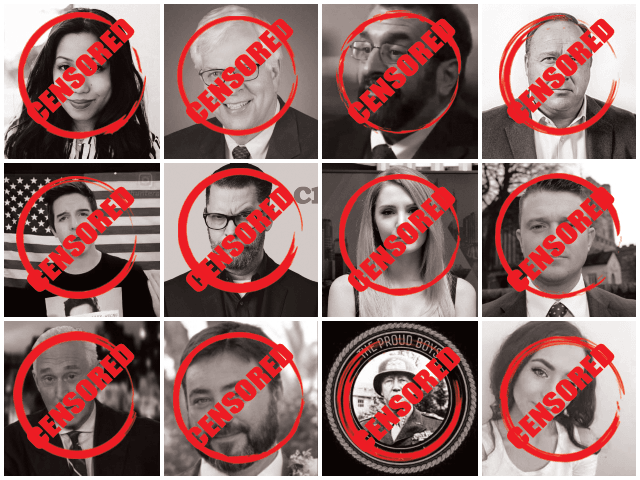
But when it came to outright suppression of conservative voices and the conservative grassroots, 2016 had nothing on 2018. This was a year in which top conservative and alternative media influencers were purged from the platform, including Roger Stone, Tommy Robinson, R.C. Maxwell, and Gavin McInnes. In the months leading to the election, Twitter also issued conservatives James Woods and Laura Loomer with temporary suspensions (Loomer has since been banned from Twitter permanently for criticizing a Democratic congresswoman). Together, the banned and suspended influencers were able to reach and influence millions of Twitter users — and in a crucial election year, Twitter took that powerful ability to mobilize the grassroots away from them.
Facebook behaved even worse, banning over 800 pages and accounts without warning in the run-up to the elections, mostly alternative media pages of the anti-establishment left and the anti-establishment right. Page owners — including Iraq war veteran and triple amputee Brian Kolfage, who invested some $300,000 in his Facebook businesses — allegedly received no warning of the upcoming ban, and no compensation for their lost investment. In true Orwellian fashion, Facebook framed their crackdown as an effort to “protect” elections from “misinformation” and “inauthentic behavior.”
Beyond the deliberate attempts to interfere in elections (or “protect” them — same thing!), conservative influencers also have to contend with the casual left-wing bias that occurs on these platforms every day.  Whether voting day is around the corner or not, the left-wing bias of big tech companies will reap its victims — as in the case of the YouTuber who nearly lost his account after posting a video of his video game character killing a suffragette character in the game Red Dead Redemption 2. 
The double standards are obvious. Influential activists like Tommy Robinson get banned from big tech platforms for posting facts, while far-left radicals get to dox their ideological opponents, encourage violence, and cheer for “Antifa” domestic terrorists with far less interference. The result is a two-tiered system, where the left can mobilize its supporters for any purpose, while the right’s ability to do so is constantly curtailed.
That’s to say nothing of the energy spent by conservatives and the right-wing media to expose censorship and bias on the part of Silicon Valley. That energy could be spent exposing Democrat wrongdoing and mobilizing voters. Conservatives and populists are forced to spend so much time defending themselves against censorship that they are forced to neglect other issues.
Democrats will cry “voter suppression” when they see a few faulty voting machines. But they’ll also call Silicon Valley censorship a “conspiracy theory,” even when big tech companies openly admit to censorship. The question Republicans should be asking: in a race as tight as the recent midterms, how many votes did Silicon Valley cost their party? And what can be done to stop it happening again?
Allum Bokhari is the senior technology correspondent at Breitbart News. You can follow him on TwitterGab.ai and add him on Facebook. Email tips and suggestions to allumbokhari@protonmail.com.

Big Tech's Authoritarian Practices Are Accelerating. Will You Submit?

Big Tech's Authoritarian Practices Are Accelerating. Will You Submit?
(AP Photo/Mark Schiefelbein)
Glenn Reynolds has deactivated his Twitter account, citing the banning of Jesse Kelly for no apparent reason as the immediate cause of his disillusionment with the platform. Explaining his decision, he wrote:
Why should I provide free content to people I don’t like, who hate me? I’m currently working on a book on social media, and I keep coming back to the point that Twitter is far and away the most socially destructive of the various platforms. So I decided to suspend them, as they are suspending others. At least I’m giving my reasons, which is more than they’ve done usually.
He may have beaten the digital bouncers to the door by only a little. The Thought Police are rushing to ensure that everyone toes the line. The Straits Times reports that "Facebook will allow French regulators to 'embed' inside the company to examine how it combats online hate speech, the first time the wary tech giant has opened its doors in such a way, President Emmanuel Macron said."
The trial project is an example of what Mr Macron has called "smart regulation", something he wants to extend to other tech leaders such as Google, Apple and Amazon.
The move follows a meeting with Facebook's founder, Mr Mark Zuckerberg, in May, when Mr Macron invited the chief executive officers of some of the biggest tech firms to Paris, telling them they should work for the common good.
The officials may be seconded from the telecoms regulator and the interior and justice ministries, a government source said. Facebook said the selection was up to the French presidency.
It is unclear whether the group will have access to highly sensitive material such as Facebook's algorithms or codes to remove hate speech. It could travel to Facebook's European headquarters in Dublin and global base in Menlo Park, California, if necessary, the company said.
This is the same Emmanuel Macron who is worried that protests by the French miserables against his crushing environmental fuel taxes could hurt the government's image:
The French president told ministers at a cabinet meeting on Monday that the government must respond after images were relayed around the world of police firing teargas and water cannon at protesters who set up barricades, lit fires and smashed restaurants and shopfronts on the Champs-Élysées.
It's not just Macron who is leaning on Google. The government of China is also exerting pressure on the tech companies to help them to build a social media surveillance state. Here's Ben Gomes, Google's search engine chief who "joked about the unpredictability of President Donald Trump and groaned about the ongoing trade war between the U.S. and China, which has slowed down Google’s negotiations with Communist Party officials in Beijing, whose approval Google requires to launch the censored search engine":China I think is one of the most interesting markets, arguably the most interesting market in the world today. Just by virtue of being there and paying attention to the Chinese market, we will learn things, because in many ways China was leading the world in some kinds of innovation. We need to understand what is happening there in order to inspire us. It’s not just a one-way street. China will teach us things that we don’t know. And the people, as you work on this, both in the Chinese offices and elsewhere, paying attention to the things that are happening there is incredibly valuable for us as Google, potentially not just in China, but somewhere else entirely.
One of the things China will pioneer, as the New York Times reports, is to use "A.I., shame and lots of cameras" to control its population:
With millions of cameras and billions of lines of code, China is building a high-tech authoritarian future. Beijing is embracing technologies like facial recognition and artificial intelligence to identify and track 1.4 billion people. It wants to assemble a vast and unprecedented national surveillance system, with crucial help from its thriving technology industry ...
China is reversing the commonly held vision of technology as a great democratizer, bringing people more freedom and connecting them to the world. In China, it has brought control.
...
“The goal is algorithmic governance.”
The control system China is implementing creates two classes of citizens: the Woke and the Haters.  The former will be rewarded and the latter banned from any responsible role in life:
China’s plan to judge each of its 1.3 billion people based on their social behavior is moving a step closer to reality, with Beijing set to adopt a lifelong points program by 2021 that assigns personalized ratings for each resident ... The Beijing project will improve blacklist systems so that those deemed untrustworthy will be "unable to move even a single step."
As Tyler Grant notes in The Hill, the basic algorithms behind the Chinese social scoring system and Western hate speech systems are essentially the same. "It’s tempting to think this government overreach is purely reserved to China, after all they did just forfeit significant freedom by electing Xi Jinping president for life. This is incorrect thinking. The rest of the world is steps away from trailing the Chinese into a surveillance state":
The U.K. fines and even imprisons people for hate speech or speech deemed abhorrent to the prevailing norms of society. The U.S. is not far behind. Last week, a Manhattan judge ruled a bar can toss Trump supporters for their political viewpoints. A recent proliferation of politically motivated boycotts seeks to punish "bad" viewpoints; protesters are eager to shout down incorrect speech. In this political climate, it’s not difficult to imagine businesses or the government assessing social benefit or worth based upon a variety of factors including political speech.
With incredible data collection, the plumbing is already in place for such a system to take hold. Our tech companies catalogue large quantities of data on everyone. As we saw with Cambridge Analytica in the 2016 election, this data can be used to steer particular viewpoints; it’s not a far cry to imagine information being used to control viewpoints.
There's nothing to lose by quitting if they're coming for you anyway. At least you get a head start.