Friday, August 30, 2019

Elizabeth Warren's Pitch for 'Economic Patriotism' Is Full of Intellectual Dishonesty and Economic Fallacies

Elizabeth Warren's Pitch for 'Economic Patriotism' Is Full of Intellectual Dishonesty and Economic Fallacies

Warren needs to take a lesson from Leonard Read's "I, Pencil."
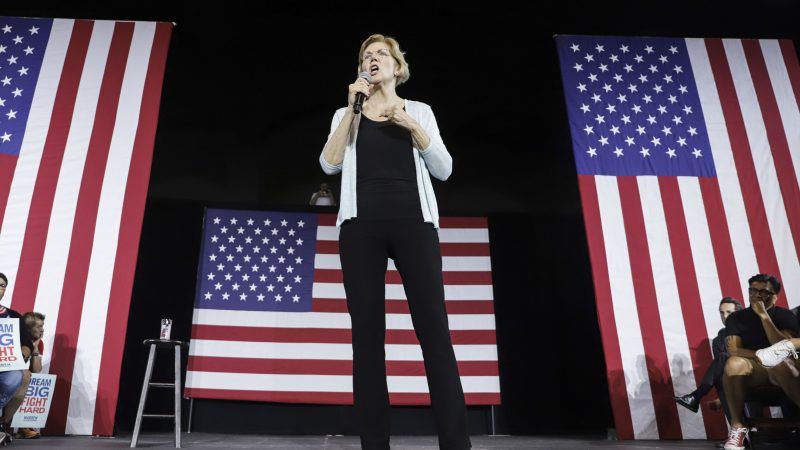
Sen. Elizabeth Warren (D–Mass.) is promising to protect Americans from the scourge of…pencils?
In a new video posted to Twitter over the weekend, the presidential candidate promises to create a new federal agency that would expand on the protectionist measures undertaken by Donald Trump. She's even borrowing Trumpian rhetoric for the project, which she calls "economic patriotism," as she promises that a Warren administration would put the interests of American workers first.
Warren's attack on corporations that supposedly harm Americans by shifting jobs overseas is full of intellectual dishonesty and economic fallacies. Rather than making a case for greater government involvement in the corporate boardrooms of America, the video succeeds only at highlighting how misinformed and misguided such interventions are, regardless of whether they are executed by Trump or Warren.
"There are a lot of giant companies who like to call themselves 'American,' but face it: they have no loyalty or allegiance to America," she says in the video.
As proof, Warren points to the "famous no. 2 pencil," which is mostly manufactured in Mexico and China. Her video doesn't make clear why pencils should have to be made in America—or why that lack of good, pencil-making jobs in America is a problem.
That Warren chose to use pencils to illustrate the supposed need for "economic patriotism" is darkly hilarious to anyone familiar with "I, Pencil," Leonard Read's 1958 parable about the merits of free markets and comparative advantage. Reed's lesson is that no one on the planet has the means or knowledge to make an item as mundane and ubiquitous as a simple pencil. A pencil requires wood, graphite, brass, and rubber, but each component part is the result of supply chains that might stretch around the world—from the forests of the Pacific Northwest to the mines of Mexico to the factories of Indonesia.
"Neither the worker in the oil field nor the chemist nor the digger of graphite or clay nor any who mans or makes the ships or trains or trucks nor the one who runs the machine that does the knurling on my bit of metal nor the president of the company performs his singular task because he wants me," Read wrote in the role of the eponymous pencil. "Each one wants me less, perhaps, than does a child in the first grade."
And yet we have pencils. Tons of them. Not only that, but the process for obtaining and combining those various component parts is so efficient—despite "the absence of a master mind" directing all those activities, Read notes—that you can buy dozens of pencils for no more than a few dollars. The simple pencil is a miracle of the modern world, and of trade that crisscrosses national borders.
What is true about pencils is true about almost everything else you buy too. There's not really any such thing as an "American" or "foreign" automobile anymore. Not when the world's biggest BMW plant is in South Carolina, and when the assembly line for a single car seat might zig-zag across the U.S.-Mexico border five or six times. The iPhone is engineered in the United States, is manufactured in China, and contains components sourced all over the world.
That Warren fails to grasp this—or that she cynically believes voters don't grasp it—makes her no better than Trump when it comes to trade policy. Indeed, Trump's use (and abuse) of executive power to implement his own myopic and self-defeating trade policies may have only paved the way for a more competent protectionist like Warren, if she ends up in the White House.
It's worth noting that Warren's proposal for a new federal department to oversee her "economic patriotism" scheme would potentially streamline some government functions. She says the new Department of Economic Development would replace the Commerce Department and "a handful of other government agencies." Consolidation of the federal bureaucracy can be a good way to root out unnecessary overlap between existing agencies, but this seems like an effort at reorganizing a bunch of things the feds shouldn't be doing in the first place.
Beyond that, there's little truth to the claim that American manufacturing has been hollowed out by trade. Foreign investment in American manufacturing reached record highs in 2018, and American manufacturing output has tripled since 1980.
Warren's proposal smacks of a disingenuous attack on the benefits of free markets, with Warren trying—and failing—to make American corporations seem like a foreign threat.
"The truth is," she claims in the video," these American companies have only one real loyalty, and that's to their shareholders, a third of whom are foreign investors."
What about other two-thirds of those shareholders Warren is trying to demonize? Well, they would be Americans, of course.

Thursday, August 29, 2019

James Comey is proof the ‘deep state’ is something to fear

James Comey is proof the ‘deep state’ is something to fear


For nearly three years now, those who promise to save us from the wicked clutches of President Donald Trump have bombarded America with lectures about the “rule of law.” Yet, over and over again, these self-styled champions of justice feel free to disregard the law whenever it suits them. The latest example is former FBI Director James Comey.
A new report by the Office of the Inspector General for the Justice Department found that Comey had written FBI memos, illicitly passed them on to a lawyer friend, who in turn leaked them to a friendly New York Times reporter who had been spreading the Russian conspiracy theory.
Why? Because Comey was interested in extracting revenge on the man who had fired him, Donald Trump.
Comey, the report found, had leaked “investigative information, obtained during the course of FBI employment, in order to achieve a personally desired outcome.”
That outcome, as Comey had admitted to Congress, was to “prompt the appointment of a special counsel” to investigate the president’s alleged conspiracy with the Russian government to win the 2016 election. By doing this, the DOJ inspector general, who is widely considered both meticulous and unbiased, found that Comey had “set a dangerous example” and “releas[ed] sensitive information” to “create public pressure for official action.”
It worked. And by manufacturing an investigation into the president — one that he didn’t have enough evidence to pursue in an official capacity — Comey had not only abused his power but plunged the nation into two years of hysterics about Russian interference.
In the end, Comey’s good friend Robert Mueller, despite his best efforts, couldn’t ferret out a single instance of criminal conspiracy.
If you want to know why so many Americans believe there’s a “deep state” working against their interests, look no further than men like Comey. We have growing evidence that senior officials in the FBI and CIA acted as partisan opponents of the duly elected president, abetting and inciting partisan investigations.
Americans will continue to lose trust in institutions, if leaders keep misappropriating power for political purposes. Comey claimed he leaked his memos because they were of “incredible importance to the Nation, as a whole,” which is what everyone who has ever pursued arbitrary and capricious power says to rationalize their abuse.
David Harsanyi is a senior editor at The Federalist.

The tragic — and overlooked — fallout from the ’60s sexual revolution

The tragic — and overlooked — fallout from the ’60s sexual revolution


Declining life expectancy, mass shootings, alarming rates of mental illness, rising white nationalism, the opioid crisis: By many measures, our society is in trouble, and we are ignoring a root cause: the unprecedented familial dispersion that followed the 1960s sexual revolution.
At heart, that revolution aimed to radically sever human sexuality from marriage and child-rearing, from the responsibilities society had hitherto imposed on the individual sexual appetite. Afterward, fatherless homes, family shrinkage and breakup, childlessness and abortion all became commonplace. The net effect of these changes is having fewer people to call one’s own.
Many Americans would say that their own lives have been enhanced mightily by the new liberties wrought by the ’60s revolution. Perhaps. But if we examine what these same changes have delivered at a collective level, an unsettling picture emerges.
One feature of the new landscape is widespread loneliness. And while initial studies were trained on the isolated elderly, scholarly focus is rapidly expanding as social-science data reveal ravaging isolation at the opposite end of the spectrum.
On July 30, the same day that a shooter murdered two people at a Walmart in Southaven, Miss., the latest survey by YouGov reported that 30 percent of young people in their sample of 1,254 say they “always or often” feel lonely.
Like any social phenomenon, the systemic outbreak of loneliness has more roots than one. But surely its fundamental source, for young and old alike, is the arithmetical one: the fact that more and more people now pass through life without father, sister, brother, children, cousins or varying combinations of the above — and sometimes without any of the above.
Or consider another signal development of the age that also contributes to social disunity: identity politics. In this case, too, dots connect to post-1960s kinship implosion. “The Combahee River Collective Statement,” agreed by all to be the founding document of such politics, is a manifesto acclaiming group identity as the most important source of power and protection.
It was issued in 1977, just as the first generation born after the sexual revolution came of age. It was the creation of a group of black feminists, representing a demographic cohort that was the first to experience rising and disproportionate rates of abortion and fatherlessness.
“The only people who care enough about us to work consistently for our liberation are us,” these feminists said plaintively. That statement captured a sad reality that would soon become true for many more Americans: not even having family to count on.
The fracturing of the post-1960s family and the flight to collective identities have not only been occurring at the same time. As the timeline and other evidence show, they cannot be understood apart from one another.
Identity politics is also a product of the revolution in another way. Whether one looks left or right, to politics or culture, the question, “Who am I?” has become the most frantic of our time. Traditionally, that question has been answered at least in part via primordial relations: I am a sister, a daughter, a cousin, a mother, a grandmother.
When answers that revert to family identity are more attenuated than ever before, “Who am I?” gets answered in a different way. Today’s identity communities operate as the robust family once did actually, offering members a secure place in the group, surrounding them with a simulacrum of siblings and loved ones and having their backs. But they remain shaky substitutes for the real thing.
So yes, let’s do everything we can to help our country as disparate voices urge: Reduce racism, rein in vile forms of electronic entertainment, flag potential killers, work toward a more civil order. America still won’t get better for good without a thorough diagnosis of our underlying malady.
If we are truly to recover and move on, we must begin with an honest reckoning of the impact of decades of decisions taken in the name of “choice” — whose collective deleterious effects on society are such that no single individual would have chosen them.
Mary Eberstadt is author of the new book “Primal Screams: How the Sexual Revolution Created Identity Politics.” She can be contacted at maryeberstadt.com.

PAUL SPERRY: THE WAITING GAME

PAUL SPERRY: THE WAITING GAME

Like the enemies of the United States in the Chinese and Iranian regimes, American intelligence agencies are waiting out President Trump. In this case, they are waiting out Trump to suppress the evidence of their wrongdoing in the 2016 presidential campaign. At RealClearInvestigations, Paul Sperry reports in “U.S. Intel Gatekeeper Dragging Feet on Trump-Russia Files, Insiders Say.” The whole thing is worth reading, but the first section especially warrants the attention of interested readers. RCI authorizes the republication of its articles with attribution and we are happy to take advantage of the opportunity here. Sperry writes:
More than three months after President Trump granted his attorney general unprecedented power to declassify intelligence files, key U.S. intelligence agencies are still withholding documents related to the Trump-Russia affair, say people with direct knowledge of White House discussions on the subject.
The source of the logjam: the Office of the Director of National Intelligence, which Trump is in the process of shaking up after the resignations last month of its director, Dan Coats, and principal deputy, Sue Gordon. “Establishment” officials in that agency are still dragging their feet, say the sources, who spoke on condition that they not be further identified.
Sources who have seen the documents generally described their contents to RealClearInvestigations. They said the material still under wraps includes:
Evidence that Prseident Obama’s CIA, FBI, and Justice Department illegally eavesdropped on the Trump campaign — cases separate from the FBI’s disputed FISA court-approved surveillance of Trump campaign adviser Carter Page.
• An August 2016 briefing CIA Director John Brennan hand-delivered in a sealed envelope to Obama, containing information from what Brennan claimed was “a critical informant close to Putin.” The informant is believed to have actually been a Russian source recycled from the largely debunked dossier compiled by ex-British agent Christopher Steele for the Hillary Clinton campaign.
• An email exchange from December 2016 between Brennan and FBI Director James Comey, in which Brennan is said to have argued for using the dossier in early drafts of the task force’s much-hyped January 2017 intelligence assessment. That spread the narrative that Russian President Vladimir Putin ordered the alleged Clinton campaign hacking to steal the election for Trump.
• Copies of all FBI, CIA and State Department records related to Joseph Mifsud, the mysterious Maltese professor whose statements regarding Papadopoulos allegedly triggered the original Russia-collusion probe.
• Transcripts of 53 closed-door interviews of FBI and Justice Department officials and other witnesses conducted by the House Intelligence Committee. The files were sent to the agency last November.
The transcripts “demonstrate who was lying and expose the bias that existed against Trump before and after his election,” said Rep. Matt Gaetz (R-Fla.) of the House Judiciary Committee. They also reportedly contain evidence of a Democratic National Committee attorney maintaining Russia-related contacts with the CIA during the 2016 campaign….
Whole thing here.

Finally, conservatives have a street fighter as president

Finally, conservatives have a street fighter as president

Has there been a president in living memory who relishes a fight more than Trump?  I don't think so. That is a major reason why he remains popular with conservatives and has seen his favorability ratings rise.
Sure, I like President Trump's actions on job-killing regulations, tax relief, border security, energy independence, military funding, judicial appointments, and so on.  But what really invigorates me and millions of other EverTrumpers is that he is fearless -- impervious to attacks by his adversaries and merciless in responding to them. 
Trump is an oddity: a Republican president who stands up to the Left's defamations and brickbats and returns fire.  His prickly personality is one driving force; another is Twitter, the social media megaphone he uses to bypass the legacy media's censors.
Especially gratifying to his base is Trump's war on PC and his refusal to be restrained by liberals' standards of what constitutes acceptable speech.  Go after him and your race or ethnicity will not protect you from his wrath.  House Oversight Chairman Elijah Cummings learned this lesson recently, to his chagrin.  In a nation where Trumpers are afraid to wear a MAGA cap in public, who else would dare to call out a civil rights icon on conditions in his district? 
The drumbeat of criticism and calumny directed at the president by his political opponents and the media have had no discernible physical or emotional effect on him, except perhaps to make him more energetic and determined, and his tweets more sharply worded and devastating.  Meanwhile, those who spew venom in their rage against the man are diminished.  (See the latest comment by Rob "Meathead" Reiner.)  As he fends off with alacrity the daily assaults on his character, intelligence, and motives, supporters like me are heartened. 
TDS hard cases appear to believe the deplorables will desert Trump in droves after he is impeached and in the dock.  Wishful thinking.  Not only will the base remain loyal, his favorability will continue to increase when independents and fence sitters tune in and get a load of insufferable Democratic prosecutors trying to make something of nothing.
More reasonable Trump haters hope a Senate trial tarnishes Trump and his presidency leading up to November 2020.  More likely, voters would punish Democrats for inflicting a show trial on the nation.
In their efforts to convince America Trump is the problem, the perpetrators of the Deep State coup and their allies are buttressing the case that Trump is the solution to what ails America.  
When the president arguably goes over the top, I might shake my head a little, and then I forget it.  I've waited a long time for a street fighter on my side of the political divide to occupy the Oval Office.  It's finally happened, and I couldn't be more pleased. 
Steve Grammatico is the author of You Hear Me,  Barack?: PC-Free Conservative Satire.  He blogs at You Hear Me, Barack?  A Repository of Conservative Satire, where he’s reprised from the book another piece of satire on Hapless Joe Biden.


Read more: https://www.americanthinker.com/blog/2019/08/finally_conservatives_have_a_street_fighter_as_president.html#ixzz5xkvwWQGu
Follow us: @AmericanThinker on Twitter | AmericanThinker on Facebook