Thursday, September 1, 2022

Here’s Why College Prices Have Spiraled Out Of Control And Bailouts Won’t Help

OPINION

Here’s Why College Prices Have Spiraled Out Of Control And Bailouts Won’t Help

By Kenneth Schrupp for RealClearHistory

With the Biden administration’s announcement this week that it would continue the moratorium on student loan payments through the beginning of next year and will forgive up to $20,000 in student loan debt per student, student loan forgiveness is at the top of the current political agenda. Meanwhile, there’s little talk about bringing the cost of college under control, or why the cost of college became so outrageous in the first place. 

While proponents of student loan forgiveness argue American taxpayers need to pick up the student debt tab to level the racial and socio-economic playing field, the reality is debt forgiveness disproportionately benefits the well-off and educated, as the wealthiest 40% of Americans hold 58% of student debt, and 56% of debt is held by those with prestige and income-boosting post-bachelors’ degrees. 

RELATED: Biden Student Loan Amnesty Specifically Benefits D.C. Staffers

Instead of forcing the 87% of American adults who don’t have student loans to pay for the college experience of educated elites, American leaders must reform the universal federal student loan program that has driven the cost of college to grow eight times faster than wages.

Until 1965, the cost of college at private and public institutions remained fairly in line with inflation — these were the good old days, when a minimum wage summer job could cover all of one’s annual tuition, and then some. So what happened in 1965? President Lyndon B. Johnson passed the Higher Education Act, which created guaranteed student loans by subsidizing capital for banks that would provide loans to low and middle income students. 

This simultaneously expanded college access, especially for less privileged students seeking to attend private institutions, while keeping loan burdens manageable because private banks still controlled who could receive student loans and for how much. From 1964-77, the tuition at private universities grew 11.5% more than inflation as rising demand oustripped supply, while that at public institutions, it grew 1.6% less than inflation as the government massively expanded public college systems to accommodate an exploding college-age population fueled by the Baby Boom. 

Carter created unlimited, guaranteed college demand

This bank-dominated system remained in place until 1978, when an economy in shambles and the pressures of the Baby Boom’s succeeding Baby Bust on empty college classrooms prompted President Jimmy Carter to pass the Middle Income Student Assistance Act, which eliminated income requirements for student loans.

At a time when colleges otherwise would have had to cut tuition or cohort sizes to stay full, this new bill ensured that anybody could be a full time student. 

With this bill creating unlimited, guaranteed college demand, college tuition hikes were off to the races; from 1978-92, tuition at private universities grew 50.7% more than inflation, while that at public universities, it grew 25.4% more than inflation. Pretty dismal, right? Well, things got worse. 

RELATED: Biden Setting Up Student Loan ‘Forgiveness’ For Well-Off Borrowers, After Pelosi Said He Has No Such Power

In 1992, the Higher Education Reauthorization Act introduced direct, guaranteed loans from the Department of Education itself, and, in response to higher tuition, removed borrowing limits, which removed any last incentive for schools to keep costs down. From 1993-2006 (the endpoint of the common data set used in this analysis), tuition at private schools grew 39% more than inflation, whereas that at public schools rose 47% more than inflation.

These massive increases were a result of large cuts in state funding for public universities (who increased tuition to offset these losses) and growing room and board fees (which were used to impose higher costs on students without having to increase headline tuition as much). 

Debt forgiveness encourages rising tuitions

Without any changes to the federal student loan program, all debt forgiveness does is encourage a never-ending cycle of higher tuition, crushing debt, more bailouts, and more graduates lacking the positive equity to buy a house or even a wedding ring. A return to something more like the 1965 Higher Education Act but without federal loan guarantees — a mix of privately issued loans, low-interest capital, and strict requirements ensuring the loans would only serve lower and middle income students — would be a significant and realistic improvement.

Banks would be more careful in issuing loans, taking care to make sure students aren’t overwhelmed with debt they’d never afford to repay. 

By combining this reform with a database of student debt-to-income ratios ranked by college and by major, students would be empowered to make more informed financial decisions, and schools with unsustainable programs would find themselves either short of students or named-and-shamed into improvement.

Requiring colleges to present average pay per major at that school upon graduation would probably also do wonders for helping students choose majors that make financial sense for them. 

Purdue’s model worth considering

While politically infeasible, one could also even imagine a future where the federal government isn’t involved in issuing student loans at all, a world in which banks and schools create new financing programs on their own — and at their own risk. One school that has embraced an alternative funding model is Purdue University, a public institution ranked as one of the top 50 universities in our nation.

RELATED: Florida Gov. DeSantis Ramps Up Effort To Fight Against Woke Agenda In State Universities

Purdue has not only frozen its tuition since 2012, but it has also created a viable alternative financing model that leaves students tuition-debt free while encouraging them to make effective financial decisions. 

With Purdue’s Back a Boiler program, one can choose to pay no tuition during school, but pay a percentage of one’s earnings based on the typical Purdue graduate pay for that major over a period of 10 years.

Though the cost to the student over the program’s lifetime is slightly cheaper than private loans and slightly more expensive than federal loans, the real difference is the university, not the student or the federal government, is the one ultimately responsible for potential losses and benefits — it’s up to Purdue to invest in its students success or suffer the financial consequences. 

This alignment of risk and reward with the agent responsible for the quality and value of the product — Purdue is incentivized to produce high quality graduates to maximize their returns, while keeping administrative bloat and other bureaucratic waste down to keep costs in check. If colleges across this country were to offer this model, it’s highly likely we’d see drastic improvements in quality and reductions in the cost of higher education across the board. 

Why a bailout isn’t fair

But at the same time that we lament the cost of college, we also must remember that, once accounting for socioeconomic differences, men with bachelor’s degrees earn $655,000 more in median lifetime earnings than those with only high school diplomas, while women with bachelor’s earn $450,000 more.

With the average undergraduate student debt load at $28,400, this means the rate of return on average debt at graduation is 1,585%. A widespread bailout is hardly fair given the vast improvement in lifetime earnings that exists despite the contrivances of the federal student loan program.

Indeed, the federal student loan program has suffered the same fate of nearly every well-meaning but short-on-foresight subsidy. Modest successes from a limited-scope program drive the creation of reliant and growing constituencies who expand the program to the point of bloat and failure, ultimately doing more harm than help to the beneficiaries the program was built to serve.

RELATED: Elite Universities Are The Worst For Free Speech

In this case, the federal student loan program has financially impacted generations of Americans, leaving millions with debt and created a situation where the same government that created the problem can come in on a shining horse to save the day over and over again — politically, federal student loans are the gift that doesn’t stop giving. 

To put an end to this scheme of student suffering, bureaucratic bloat, and political ponies, we have little choice but to turn back the clock on the federal student loan program, either returning loan-origination for federally subsidized loans back to banks or replacing the federal loan system entirely.

Otherwise, like clockwork every election cycle, politicians will dangle the carrot of debt relief before desperate students all too eager to vote for their own demise, over and over again until the whole system comes crashing down.

Syndicated with permission from Real Clear Wire.

Kenneth Schrupp is a Young Voices contributor writing on the intersection of business, politics and media. He also serves as editor-in-chief of the California Review, an independent journal.

https://thepoliticalinsider.com/heres-why-college-prices-have-spiraled-out-of-control-and-bailouts-wont-help/

FACING THE TRUTH ABOUT LOCKDOWNS

FACING THE TRUTH ABOUT LOCKDOWNS

BY JOHN HINDERAKER IN CORONAVIRUSLIBERALS

In my opinion, the responses of governments to the covid epidemic represent the worst failure of public policy since, at least, the Vietnam War. In fact, the covid responses were probably more destructive than Vietnam. You would likely have to go back to the perverse reactions of the Hoover/Roosevelt administrations to the Great Depression to find their equal.

The centerpiece of governments’ efforts to “fight” the covid virus was lockdowns of businesses, schools, churches, and social life generally. No one ever doubted that these lockdowns entailed terrible costs, and it pretty quickly became clear that they conferred few if any benefits. But many governments around the world, including our own with the collaboration of tech magnates, ruthlessly suppressed debate over their advisability.

That is finally changing, as more and more observers are willing to say what pretty much everyone knows: the shutdown emperors weren’t wearing any clothes. See, for example, former British Supreme Court Justice Jonathan Sumption in the hyper-establishment London Times: “Little by little the truth of lockdown is being admitted: it was a disaster.” The whole thing is worth reading. Here are some excerpts:

Lockdown was an extreme and unprecedented response to an ancient problem, the challenge of epidemic disease. It was also something else. It marked one of the gravest governmental failures of modern times. In a remarkably candid interview with The Spectator, Rishi Sunak has blown the gaff on the sheer superficiality of the decision-making process of which he was himself part.
***
Lockdown was a policy conceived in the early days by China and the World Health Organisation as a way of suppressing the virus altogether (so-called zero Covid). The WHO quickly abandoned this unrealistic ambition. But European countries, except Sweden, eagerly embraced lockdown, ripping up a decade of pandemic planning that had been based on concentrating help on vulnerable groups and avoiding coercion.

Likewise in nearly all American states.

At first Britain stood up against the stampede. Then Professor Neil Ferguson’s team at Imperial College London published its notorious “Report 9”. Sunak confirms that this was what panicked ministers into a measure that the scientists had previously rejected. If No 10 had studied the assumptions underlying it, it might have been less impressed. …

And, as Report 9 pointed out, lockdown would not destroy the virus. It would come back as soon as the restrictions were lifted. …

It was always obvious that you could not close down a country for months on end without serious consequences. The shocking thing that emerges from Sunak’s interview is that the government refused to take them into account. There was no assessment of the likely collateral costs of lockdown. There was no cost-benefit analysis. There was no planning. In government the issues were not even discussed. Sunak’s own attempts to raise them hit a brick wall. Ministers took refuge in evasive buck-passing, claiming to be “following the science”.

Same in the U.S. But of course, “science” could never tell us whether slowing the spread of the covid virus–assuming that could be done–was worth destroying hundreds of thousands of businesses, devastating the lives of our young people, planting the seeds of future illness and death due to foregone “non-essential” medical checkups and procedures, and so on. Politicians, with few exceptions, took the coward’s way out.

We are still paying for this negligence, and our children and grandchildren will be paying for it for decades to come. In 2020, UK GDP fell by nearly a tenth, the biggest hit to the economy for at least a century. According to Treasury estimates, 460,000 people left the workforce never to return. The policy took a wrecking ball to the public finances. The IMF estimates that government spending rose by more than £400 billion, or about £6,000 for every man, woman and child. Most of this was unproductive spending. It went on paying people for not working and supporting businesses forced to cease operations. …

Then there are the non-financial costs. Other mortal conditions went undiagnosed and untreated. In October 2020, after four months of lockdown, the Office for National Statistics reported more than 25,000 excess deaths at home from conditions such as cancer, heart disease and dementia. A year after the last lockdown ended, the NHS still has a vast backlog. Excess deaths, 95 per cent of them due to conditions other than Covid, are running at about 1,000 a week. There has been a huge impact on mental health, with children and the poor worst affected.

The numbers would be different in the U.S, but the conclusion is the same.

The lockdown was an experiment in authoritarian government unmatched in our history even in wartime.

My own governor issued an order that said no one in the state could leave his or her house except as permitted by the governor. Is there a word for this kind of high-handed, unconstitutional authoritarianism?

Ministers and scientists responsible for a policy that has inflicted untold misery on an entire population naturally find it hard to admit they may have been mistaken. But closing ranks against the public interest usually fails in the end. There will be more embarrassing disclosures after this one. The official narrative is beginning to unravel.

Let’s hope so–here in the U.S., as well. As the official narrative does unravel, the last to know will be those who depend on Twitter, YouTube and Facebook for their news. I have a feeling that ignorant tech employees will keep fighting the shutdown battle long after the war is over.

https://www.powerlineblog.com/archives/2022/08/facing-the-truth-about-lockdowns.php

Peter Schweizer: ‘My Son Hunter’ Is ‘Information Lifted from the Pages of My Book and Turned into Flesh’

Peter Schweizer: ‘My Son Hunter’ Is ‘Information Lifted from the Pages of My Book and Turned into Flesh’

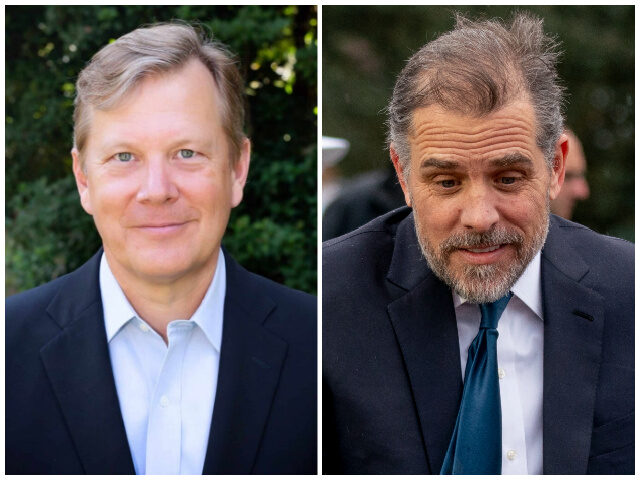
peter-schweizer-hunter-biden-getty
AP Photo/Andrew Harnik
5:30

Peter Schweizer, the #1 New York Times bestselling author of Red Handed: How American Elites Get Rich Helping China Windescribed the upcoming film My Son Hunter as “information lifted from the pages of my book and turned into the flesh.”

Schweizer, who is also a Breitbart News senior contributor and president of the Government Accountability Institute, made his comments during a panel discussion Thursday night on Truth Social hosted by former California congressman and current Truth Social CEO Devin Nunes.

Watch the panel:

My Son Hunter, which marks Breitbart’s expansion into film distribution, was a crowdfunded project inspired by the investigative reporting of Schweizer and Breitbart News about the Biden family’s corruption.

Schweizer, who was the first to report on Hunter Biden’s corrupt business dealings with foreign governments at a time when his vice president father was negotiating U.S. foreign policy with those regimes, described My Son Hunter as an entertaining “shorthand version” of his 300-page bestselling book chronicling the Biden family corruption.

“I think what people are going to get in this film is information lifted from the pages of my book and turned into the flesh,” Schweizer said.

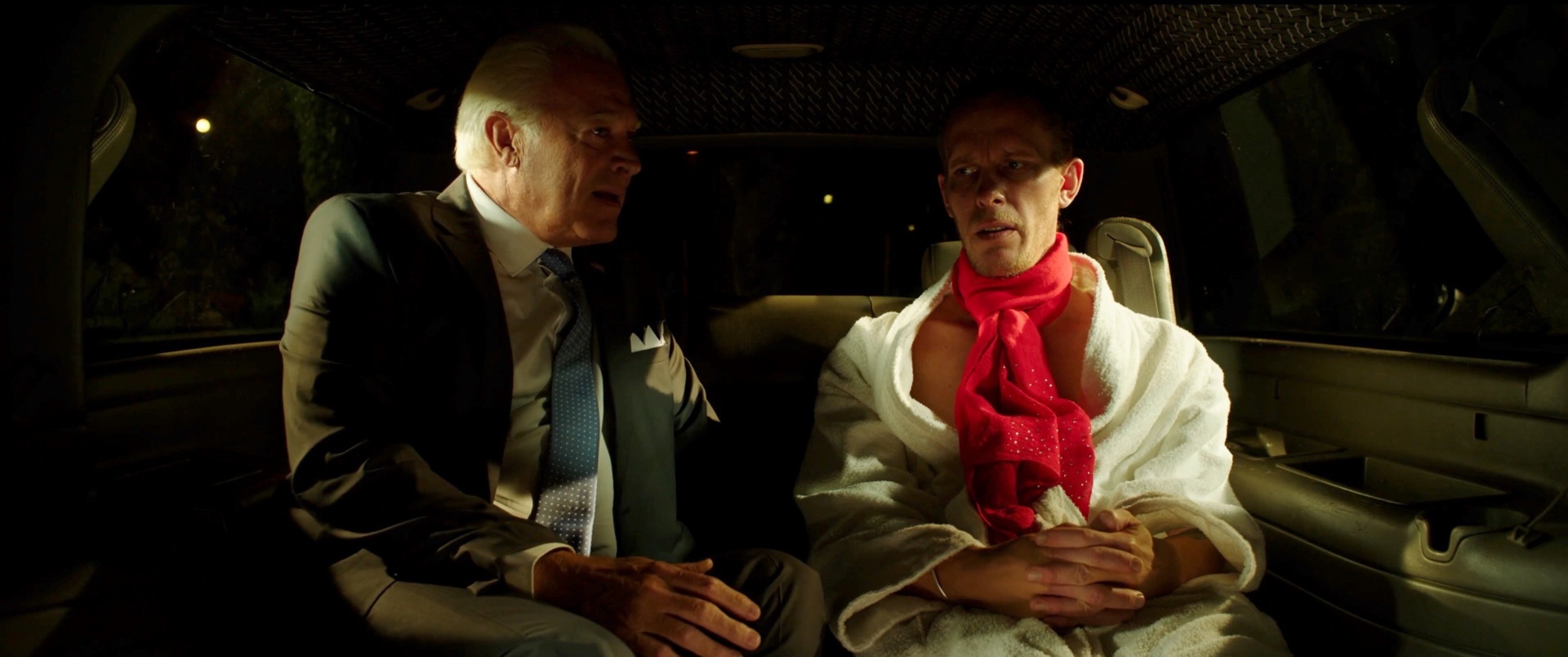
Scenes from “My Son Hunter” featuring Emma Gojkovic, Laurence Fox, Gina Carano, and John James. (Courtesy of MySonHunter.com)

In fact, Schweizer said that the truth about Hunter Biden’s corruption seems almost too outrageous for fiction.

“It’s such an unbelievable story in a way,” Schweizer said. “I mean, imagine if you were a screenwriter, and you went to producers in L.A. and you said, ‘Hey, I’ve got this idea for a film. It’s going to be [about] the vice president’s son. He’s going to take tens of millions of dollars from the Chinese. He’s going to be a coke addict. And then he’s going to leave his laptop computer at a repair store. And that thing’s going to [be made public], but the mainstream media is going to try to cover it up.’ I mean, the producers would just laugh you out of the room. Yet, that’s exactly what happened.”

The bestselling author also praised the film’s ability to capture the complexity of the relationship between Hunter Biden and his father with both humor and sincerity.

“I think this is what will surprise a lot of people: the complexity of the Joe and Hunter Biden relationship because they talk about how much love they have for each other, and I’m sure that that’s part of it. But it’s a very complex, layered relationship,” he said. “I think there is frustration and resentment that Hunter has towards his father because he’s expected to bag all this money for the family, and he’s put in these situations. And I think the film captures that perfectly.”

John James and Laurence Fox in “My Son Hunter.” (Courtesy of MySonHunter.com)

The Truth Social panel—which also include Donald Trump Jr., My Son Hunter director Robert Davi (Licensed to Kill, Die Hard, The Goonies); and Breitbart Editor-in-Chief Alex Marlow—was quick to note the Justice Department and the FBI’s disparate handling of the Trump and Biden families, as evidenced by the treatment of Hunter Biden.

“I’ve investigated corruption for decades on going after Republicans and Democrats,” Schweizer said. “The treatment that the Bidens and received compared with the treatment of the Trumps, there’s absolutely no comparison.”

Schweizer called the Biden family corruption “absolutely the worst that I’ve seen.”

“You literally have the most powerful family in the United States taking money from our sworn rivals’ and taking it from four businessmen who are linked with Chinese intelligence,” Schweizer stated.

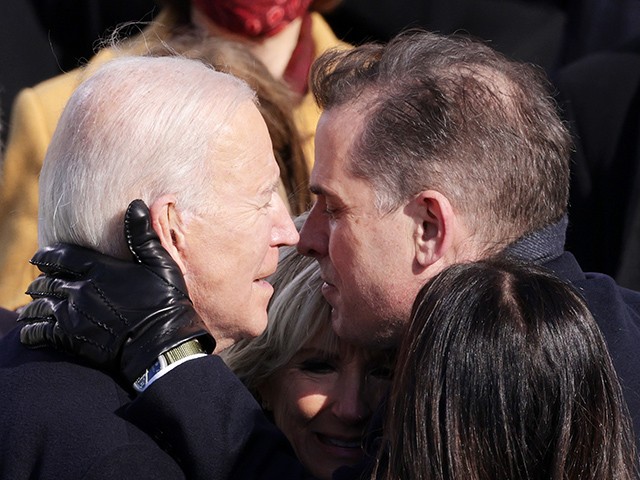
WASHINGTON, DC - JANUARY 20: U.S. President Joe Biden hugs his son Hunter Biden, wife Dr. Jill Biden and daughter Ashley Biden after being sworn in as U.S. president during his inauguration on the West Front of the U.S. Capitol on January 20, 2021 in Washington, DC. During today's inauguration ceremony Joe Biden becomes the 46th president of the United States. (Photo by Alex Wong/Getty Images)

President Joe Biden hugs his son Hunter Biden during his inauguration at the U.S. Capitol on January 20, 2021, in Washington, DC. (Alex Wong/Getty Images)

He also praised the film’s portrayal of the “transactional nature” of Hunter Biden’s dealings with foreign power players, especially his dealings in China.

“For all the crazy stuff that Hunter Biden was doing—for all the money he was taking from Russia and Ukraine—the stuff from China worries me the most because China is of course, our chief rival on the global stage; and I think, as the film captures perfectly, [the Bidens] had multiple deals in China. And these are people that were connected, that were sending millions of dollars to Hunter Biden, and he was literally performing no tangible business service in return,” Schweizer said.

“I’m going go out on a limb and say, I don’t think that these connected Chinese businessmen linked to the CCP, linked to Chinese intelligence, are in the habit of giving gifts with no strings attached to the politicians’ families in America,” he continued, adding that the film captured “the transactional nature” of these deals.

Schweizer said My Son Hunter’s ability to flesh out the complex research in his books is matched by its entertainment value.

“It’s also just damn entertaining,” he said. “I mean, it’s funny—it’s laugh out loud,” he said, praising the film’s ability to “take a serious, important subject and not get rid of the seriousness, but also make it entertaining.”

My Son Hunter—which is available for pre-order now and will be available for download and streaming starting September 7—stars Laurence Fox (Victoria, Inspector Lewis, The Professor and the Madman) as Hunter Biden; Gina Carano (The Mandalorian, Dead Pool, Heist) as a Secret Service Agent; and John James (Dynasty) as Joe Biden.

Watch the trailer:

My Son Hunter is available for PRE-ORDER NOW and will be available for download and streaming starting September 7.

Rebecca Mansour is Senior Editor-at-Large for Breitbart News. Follow her on Twitter at @RAMansour.

https://www.breitbart.com/entertainment/2022/08/26/peter-schweizer-my-son-hunter-is-information-lifted-from-the-pages-of-my-book-and-turned-into-flesh/