Monday, March 30, 2020

A Litany of Useless Laws Have Been Exposed By the Coronavirus

A Litany of Useless Laws Have Been Exposed By the Coronavirus

The ability to suspend these laws without fear of endangering the public opens the door to questioning their purpose.
From the start of the COVID-19 outbreak in the United States, state and local governments responded in various ways from issuing emergency orders⁠—citywide shutdowns⁠ to school closures and beyond⁠—but it’s the suspension of various laws and regulations that is exposing the unnecessary regulatory web that burdens businesses.
As often happens during emergencies, governors and mayors across the country have used executive power to waive laws and bypass regulations. This allows goods to get to the public quicker at lower cost, more service providers to enter struggling industries, and the market to respond to the crisis in countless other ways.
Lifting these regulations does not put public health or safety in jeopardy; if that were the case, they wouldn’t be lifted with such ease. But this should lead the public to question why the regulatory burdens exist at all.
In Texas, Gov. Greg Abbott waived oversize and overweight restrictions for commercial trucks and suspended requirements to register under the International Registration Plan or to obtain temporary registration, as long as the truck is registered in one US state.
Gov. Abbott also waived regulations allowing doctors to receive the same payment for over-the-phone telemedicine visits that they would for in-person visits for patients on state-regulated insurance plans.
Most notably, he waived state laws that prohibit alcohol industry trucks from delivering supplies to grocery stores saying, “by removing these regulations, we are streamlining the process to replenish the shelves in grocery stores across the state.” All of these moves allowed for the market to identify the needs of the public and fill them as quickly as possible.
In Boston, restaurants typically need a specific permit to provide carry-out service, but Mayor Marty Walsh lifted that requirement to allow for every restaurant to offer the service. Even New York City suspended its enforcement of illegal e-bikes during the crisis to accommodate for the influx of delivery orders, the state also moved to allow liquor-to-go.
Due to the increased demand, and ability for the supply chain to keep up with that demand, supermarket companies like H-E-B, Kroger, and Randall’s announced they’d be hiring thousands of additional staff. The newfound flexibility on trucking regulations means that grocers like H-E-B are deploying 1,300 trucks a day to continuously supply their stores.
In New Jersey, Bayonne ended enforcement of expired Resident and Driveway Parking permits. They also suspended issuing permits for what they consider “minor work,” like plumbing, electrical, mechanical, fire, and building. As long as contractors alert the city of the work they intend to do, the city will inspect it at a later date.
The ability to suspend these laws without fear of endangering the public opens the door to questioning their purpose. Many of these regulations appear to serve as no more than impediments to free exchange. If these measures exist simply to generate additional government revenue, the public should ask themselves, once the crisis has abated: should they exist at all?

Sunday, March 29, 2020

Tom Coburn was one of the best senators of our era

Tom Coburn was one of the best senators of our era

Former Sen. Tom Coburn, who died Saturday morning of complications from prostate cancer, was one of the finest public servants of my lifetime.
The Oklahoma Republican, a practicing obstetrician, combined fierce devotion to principle with rigorous intellectual integrity and tremendous personal decency. One of the most hard-line conservatives in first the House and then the Senate, he nonetheless enjoyed the respect and friendship of many liberal Democrats. Not the least of these was President Barack Obama, with whom he reportedly spoke in private, as a friend and sounding board, almost weekly throughout Obama’s White House tenure.
“I’m adamantly against 80 percent of President Obama’s policies,” Coburn told the Oklahoman newspaper. “But he is an honest liberal. … Am I to hate him because he has a different viewpoint than I do? Or should I love him and try to touch his heart and change him?”
When Coburn arrived on Capitol Hill in the “Gingrich Revolution” Republican class of 1994, he was an unyielding ideologue. Even then, though, there was a difference: Whereas some super-hard-liners are full of sound and fury without much thoughtfulness, Coburn obviously had depth and intellect.
Still, he perhaps lacked proportion. He and several conservatives clashed repeatedly with Gingrich. They were right on principle, but Gingrich may have been more practical in terms of accomplishing conservative goals. Gingrich, though, was certainly imperious with them and not always true to his word, and he tried to bully them rather than reason with them. The result, eventually, was that Coburn took part in an ill-advised, midterm, internal coup attempt against Gingrich in 1997 rather than more sensibly waiting to challenge the speaker at the end of that two-year legislative cycle.
Gingrich’s allies quashed the rebellion. Most of the coup leaders lost their political careers. Coburn, though, learned and grew. He abided by a term-limits pledge and retired from the House at the end of 2000, only to win an election to the Senate in 2004. There, he developed a legislative skill set to complement his strong conservative convictions.
Rather than being a gadfly, Coburn became an effective leader, without ever doing the “go-along to get-along” kind of games. He began publishing an annual Wastebook highlighting absurd government spending and also a weekly “pork report” listing egregious examples of wasteful projects from almost every federal agency. He took the lead in opposing Obamacare while pushing real healthcare reforms of a conservative variety, some of which have gone into law piecemeal over the years even without passage in a single, comprehensive bill. And, often working with Democrats, he became a leader in providing effective congressional oversight and insisting that government operate with public transparency.
As Democratic Sen. Carl Levin of Michigan put it, Coburn was “tough, fearless, and more interested in facts than politics.”
Journalists knew him as one of the few senators who would always give straight answers, and thoughtful ones, rather than poll-tested sound bites. He was both so supremely intelligent and so tirelessly industrious that a questioner knew Coburn’s information was solid, trustworthy, and in reasonable context.
Mostly, it was clear that Coburn was in the political game not for self-aggrandizement, but for real service to the public, in furtherance of what he saw as the best means of guaranteeing freedom and right reason.
I just checked my email inbox, and his last exchange with me (from the summer of 2016, on an off-the-record matter) was fitting. He ended it like this: “Thank you for loving our liberty. Tom.”
Change the period after “liberty” to a comma, and that’s what we should be saying to him.

Oxford Epidemiologist: Here’s Why That Doomsday Model Is Likely Way Off

By  Amanda PrestigiacomoDailyWire.com

Oxford Epidemiologist: Here’s Why That Doomsday Model Is Likely Way Off

By  Amanda PrestigiacomoDailyWire.com

Government policy and guidance crafted in an effort to “flatten the curve” of coronavirus-related deaths has largely been based upon an Imperial College London model headed by Professor Neil Ferguson.
The terrifying model shows that as many as 2.2 million Americans could perish from the virus if no action is taken, peaking in June.
However, that model is likely highly flawed, Oxford epidemiologist Sunetra Gupta argues.
Professor Gupta lead a team of researchers at Oxford University in a modeling study which suggests that the virus has been invisibly spreading for at least a month earlier than suspected, concluding that as many as half of the people in the United Kingdom have already been infected by COVID-19.
If this is the case, fewer than one in a thousand who’ve been infected with COVID-19 become sick enough to need hospitalization, leaving the vast majority with mild cases or free of symptoms.
With so many in the U.K. (and potentially the United States) presumably infected, so-called “herd immunity” could kick into effect, dramatically limiting the number of deaths modeled by Ferguson and company.
“The Oxford study is based on a what is known as a ‘susceptibility-infected-recovered model’ of Covid-19, built up from case and death reports from the UK and Italy,” the Financial Times explains. “The researchers made what they regard as the most plausible assumptions about the behaviour of the virus.”
The report continues: “The modelling brings back into focus ‘herd immunity’, the idea that the virus will stop spreading when enough people have become resistant to it because they have already been infected.”
While the notion of “herd immunity” has been essentially dropped in U.K. policy making, “the Oxford results would mean the country had already acquired substantial herd immunity through the unrecognised spread of Covid-19 over more than two months.”
The Financial Times emphasized: “If the findings are confirmed by testing, then the current restrictions could be removed much sooner than ministers have indicated.”
“I am surprised that there has been such unqualified acceptance of the Imperial model,” Gupta criticized.
Of course, the epidemiologist encouraged caution and suggested changes to policy and guidance only be made after more evidence can be presented.
The Oxford group is working with researchers at the Universities of Cambridge and Kent to begin antibody testing on the general U.K. population later this week by using specialised “neutralisation assays which provide reliable readout of protective immunity,” Gupta explained.
“We need immediately to begin large-scale serological surveys — antibody testing — to assess what stage of the epidemic we are in now,” the professor said.
Other respected medical professionals have offered a more optimistic look on the coming weeks and months with COVID-19, too.
For example, Stanford biophysicist and Nobel laureate Michael Levitt said this week, “The real situation is not as nearly as terrible as they make it out to be.”
Last week, Levitt emphasized: “[Y]ou need to think of corona like a severe flu. It is four to eight times as strong as a common flu, and yet, most people will remain healthy and humanity will survive.”

McCarthy: Pelosi Offered “Outright Lie” About Credit For Coronavirus Relief Bill

McCarthy: Pelosi Offered “Outright Lie” About Credit For Coronavirus Relief Bill

Clearly, all is not forgiven on Capitol Hill. Ever since she upended negotiations over the coronavirus relief bill, Nancy Pelosi has attempted to take credit for its final version. Earlier today, Pelosi claimed her “jiu jitsu” transformed the effort from a corporate bailout to a “workers first” rescue:
“We have the legislation that will come to the floor tomorrow. I anticipate, I feel certain we will have a strong bipartisan vote. We take some pride in the fact,” the California Democrat said at the Capitol during her weekly press briefing.
Pelosi — who turned 80 Thursday — said Democrats had to perform “jiu jitsu” on the Republicans’ initial proposal, which she said favored corporations over workers.
“We did jiu jitsu on it. It went from a corporate-first proposal that the Republicans put forth in the Senate to a workers-first — Democratic workers-first legislation,” she said.
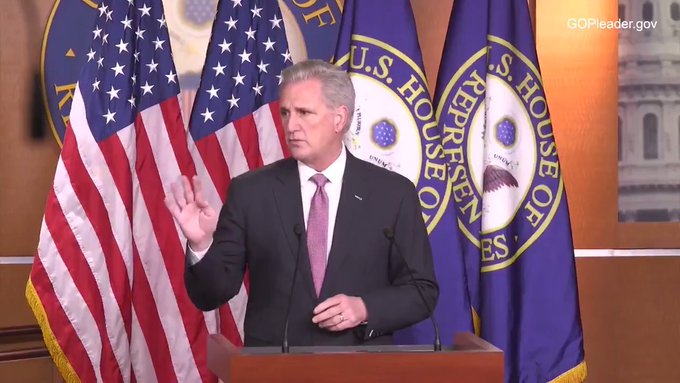
“Jiu jitsu”? More like Hong Kong phooey, McCarthy said. The only changes that took place to the bill when Pelosi belatedly injected herself into the negotiations had nothing to do with coronavirus relief.
REP. MCCARTHY: A few minutes ago the Speaker stood at the podium and claimed that House Democrats did what she called jiu-jitsu to change the bill. That is an outright lie. The fundamental portion of this bill has not changed since Sunday. Four months for unemployment was already decided on Sunday. The grant to keep employees hired by small businesses was decided on Sunday. The only few additions were funding of things that had nothing to do with the coronavirus. Was that worth holding it up and more people being laid off? More people losing sleep? More people wondering if they can continue? Those are the type of games that have to stop in Washington.
McCarthy’s got a point, of course, but this is nothing new, except for the high profile on this bill. It’s just another sunny day in Congress, where 535 people try to take full and sole credit for any success and failure’s the fault of the other side. McCarthy’s ire is particularly stoked over Pelosi’s last-minute intervention designed to grab credit for the agreement when she’d spent the past week outside of DC and the negotiations, which makes his annoyance with Pelosi’s grandstanding today completely understandable.
In exchange for that, though, Pelosi will now have no choice but push the bill through to passage tomorrow, or Saturday morning at the latest. That’s the flip side of taking ownership, and Pelosi knows it. No one really believes her when she claims that her “jiu jitsu” produced the agreement, but everyone knows she’s now on the hook for passing the bill, and fast.
All this serves to remind us that Congress is a largely dysfunctional institution that occasionally manages to work well enough to produce something in a crisis. As I wrote in my column at The Week, the final version of the $2.2 trillion bill probably matters less in the long run than the fact that elected officials managed to produce anything at all. This kind of grandstanding and sharp rebukes doesn’t promise much cooperation on later fine-tuning, however:
In this situation, the parameters of this massive relief package matters less than Congress’ credibility in dealing with a crisis. Thus far, the response has been far from confidence building, especially with an electorate whose faith in institutions had fallen sharply over the previous few years. Voters expect Congress to act in a crisis, not get stalled by partisan bickering and then literal absence. A failure to act here could have enormous political as well as economic consequences and call the whole idea of a co-equal legislature into question. …
Thus far the broad strokes look fairly focused and calibrated reasonably well on the immediate problems, but this is such an unprecedented situation that certainty is simply not possible. At this point, the nation needs to take action to prevent panic and despair from turning a short-term problem into a long-term disaster. A functional Congress and White House can fine tune the approach as it goes, adding to what works and shifting resources away from what does not.
In order for that to succeed, Congress has to become functional again and re-instill confidence in its ability to deal with crises. This agreement may not be perfect, and it may not even be great, but inaction and gridlock would be far worse than whatever problems this agreement might cause down the road. Voters are watching intently to see whether they can trust our public institutions at all, and the consequences of their failure at this junction might be far worse than the virus or the economic damage it does.
The damage Pelosi does with her “jiu jitsu” to her personal credibility is of little consequence to anyone but herself. The damage she did — and is still doing — to the institutional credibility of Congress matters far more.

As Discussion On Reopening Economy Begins, Get Ready Regardless

As Discussion On Reopening Economy Begins, Get Ready Regardless

 
As Discussion On Reopening Economy Begins, Get Ready Regardless
While COVID-19 isn’t nearly as fatal as many of us feared, one potential fatality may well be the United States economy. With businesses closed and many people unable to work or even look for work as they’re covered under “shelter in place” orders, the financial engine of the country has pretty much ground to a halt.
It’s bad enough that now much of the debate is about when to fire that engine back up.
New York Governor Andrew Cuomo has warned that being too hasty to ease the limits on travel, socialising and working together would cost lives.
“If you ask the American people to choose between public health and the economy, then it’s no contest,” he said on Tuesday.
“No American is going to say accelerate the economy at the cost of human life,” he said at a convention centre in Manhattan that is being converted into a 1000-bed temporary hospital.
New York is the worst hit by the outbreak, which has infected more than 50,000 people in the US and killed at least 660.
I don’t think anyone is saying to ignore places where the outbreak is bad and just tell everyone to go back to work. The problem is, there are people who have recovered and no longer at risk for infection that can’t work. There are places with little to no outbreak taking place that can’t work.
Now, I’m not going to get into who is right on this one. That’s not what we’re here about.
What I will say, though, is that regardless of when people get back to work and when businesses go back to being open, we’re still going to feel this one for a little while.
Even under the best-case scenario, some folks are going to be desperate. Desperate people do desperate things.
In other words, they turn to crime.
That means the rest of us owe it to our families to be very prepared for these desperate people. That means arming ourselves and keeping our skills sharp. That’s easier said than done during this day and age, but there are ways to train even while not being able to leave your house. Google is your friend on this.
It also means when things start to return to normal, you need to have a weapon on your person at all any time you legally can. You should be prepared for problems anywhere. Desperate people may do desperate things, but these aren’t your typical career criminal. They’re not likely to follow the normal patterns, so one should be wary.
And that’s if the economy fires back up relatively quickly. If it doesn’t, then things could get even worse as people break quarantine in an effort to try and find food or other essentials for their families.
While COVID-19 isn’t the Black Death, it may be enough to change far too many things about our day to day life.

Trump: Cuomo Opted for Death Panels, Lotteries Instead of Buying Ventilators

Trump: Cuomo Opted for Death Panels, Lotteries Instead of Buying Ventilators


(Photo by BRYAN R. SMITH/AFP via Getty Images)
(Correction: Fixes attribution in first paragraph.)

(CNSNews.com) - New York Gov. Andrew Cuomo had a chance to order 16,000 ventilators five years ago for a discount, but he opted for death panels and lotteries instead, President Donald Trump said Tuesday. 

During his press conference on Tuesday, Cuomo complained that the federal government only sent 400 ventilators, when they needed 30,000.


“FEMA says we're sending 400 ventilators. Really? What am I going to do with 400 ventilators when I need 30,000? You pick the 26,000 people who are going to die because you only sent 400 ventilators,” the governor said.

During Fox News’ virtual town hall, Trump responded to Cuomo’s remarks, saying, “I watched Governor Cuomo, and he was very nice. We’re building him hospitals. We’re building him medical centers, and he was complaining -- we are doing definitely more than anybody else. He was talking about the ventilators, but he should have ordered the ventilators, and he had a choice. 

“He had a chance, because right here, I just got this out that he refused to order 15,000 ventilators. I will show this to Bill,” the president said, handing the paper he was holding to Fox News host Bill Hemmer, who co-hosted the virtual town hall in the Rose Garden of the White House.

“Take a look at that, Bill. What does that say?” Trump asked.

“Is this social distancing here?” Hemmer asked.

“It says New York Governor Cuomo rejected buying recommended 16,000 ventilators in 2015 for a pandemic, established death panels and lotteries instead. So he had a chance to buy in 2015, 16,000 ventilators at a very low price, and he turned it down. I'm not blaming him or anything else, but he shouldn't be talking about us,” the president said.

“He's supposed to be buying his own ventilators. We are going to help, but if you think about it, Governor Cuomo, we are building him four hospitals. We are building him four medical centers. We are working very, very hard for the people of New York. We are working a lot with him, and then I watch him on this show complaining. He had 16,000 ventilators he could have had a great price and he didn't buy them,” Trump said.

Trump was referring to an op-ed by former New York Lt. Gov. Betsy McCaughey published March 19, 2020 by the New York Post:


Hospitals in New York are running short. To his credit, Gov. Andrew Cuomo is doing his best, but he admits “you can’t find available ventilators no matter how much you’re willing to pay right now, because there is literally a global run on ventilators.”

It’s a little late. Several years ago, after learning that the Empire State’s stockpile of medical equipment had 16,000 fewer ventilators than the 18,000 New Yorkers would need in a severe pandemic, state public-health leaders came to a fork in the road.

They could have chosen to buy more ventilators to back up the supplies hospitals maintain. ­Instead, the health commissioner, Howard Zucker, assembled a task force for rationing the ventilators they already had.

In 2015, that task force came up with rules that will be imposed when ventilators run short. ­Patients assigned a red code will have highest access, and other ­patients will be assigned green, yellow or blue (the worst), ­depending on a “triage officer’s” decision.

In truth, a death officer. Let’s not sugar-coat it. It won’t be up to your own doctor.

In 2015, the state could have purchased the additional 16,000 needed ventilators for $36,000 apiece, or a total of $576 million. It’s a lot of money, but in hindsight, spending half a percent of the budget to prepare for pandemic was the right thing to do.


Ventilator Allocation Guidelines, released in November 2015 by the New York State Task Force on Life and the Law New York State Department of Health, warned that “a severe influenza pandemic on the scale of the 1918 influenza outbreak will significantly strain medical resources, including ventilators.”

The guidelines warned that “a severe influenza pandemic on the scale of the 1918 influenza outbreak will significantly strain medical resources, including ventilators.”

In such a case, “89,610 influenza patients will require ventilators in New York State and there will not be enough ventilators in the State to meet the demand” in the case of “a severe 6-week outbreak.”

“A clinical ventilator allocation protocol will need to be implemented to ensure that ventilators are allocated in the most efficient manner to support the goal of saving the greatest number of lives,” the report said.

The 2015 report outlines what protocols will be used to determine ventilator allocation:


In 2007, the New York State Task Force on Life and the Law (the Task Force) and the New York State Department of Health (the Department of Health) released draft ventilator allocation guidelines for adults. New York’s innovative guidelines were among the first of their kind to be released in the United States and have been widely cited and followed by other states. Since then, the Department of Health and the Task Force have made extensive public education and outreach efforts and have solicited comments from various stakeholders and the Task Force reexamined and revised the adult guidelines (Adult Guidelines). 

The primary goal of the Guidelines is to save the most lives in an influenza pandemic where there are a limited number of available ventilators. To accomplish this goal, patients for whom ventilator therapy would most likely be lifesaving are prioritized. The Guidelines define survival by examining a patient’s short-term likelihood of surviving the acute medical episode and not by focusing on whether the patient may survive a given illness or disease in the longterm (e.g., years after the pandemic). Patients with the highest likelihood of survival without medical intervention, along with patients with the smallest likelihood of survival with medical intervention, have the lowest level of access to ventilator therapy. Thus, patients who are most likely to survive without the ventilator, together with patients who will most likely survive with ventilator therapy, increase the overall number of survivors. 

There are five components of the ethical framework that underlie the Adult Guidelines. The duty to care is the fundamental obligation for providers to care for patients. The duty to steward resources is the need to responsibly manage resources during periods of true scarcity. The duty to plan is the responsibility of government to plan for a foreseeable crisis. Distributive justice requires that an allocation system is applied broadly and consistently to be fair to all. Transparency ensures that the process of developing a clinical ventilator allocation protocol is open to feedback and revision, which helps promote public trust in the Adult Guidelines. 

In order to maintain a clinician’s duty to care, a patient’s attending physician does not determine whether his/her patient receives (or continues) with ventilator therapy; instead a triage officer or triage committee makes the decision. While the attending physician interacts with and conducts the clinical evaluation of a patient, a triage officer or triage committee does not have any direct contact with the patient. Instead, a triage officer or triage committee examines the data provided by the attending physician and makes the decision about a patient’s level of access to a ventilator. The decision to use a triage officer or committee is left to each acute care facility (i.e., hospital) because available resources will differ at each site.
 https://www.cnsnews.com/article/national/melanie-arter/trump-cuomo-opted-death-panels-lotteries-instead-buying-ventilators